

Best Forex Trading Strategies for Beginners (Low Risk Methods)
Forex trading can look exciting from the outside, but beginners usually lose confidence when they jump into fast, aggressive methods too early. Popular trading guides list trend trading, swing trading, scalping, mean reversion, breakout trading, and day trading as common forex approaches, but they also show that not all of them carry the same level of risk or suit the same personality.
If your goal is to learn the market without taking unnecessary risk, the best forex trading strategies for beginners are the ones with clear rules, slower decision-making, and strict money management. One beginner-focused guide says swing trading is often the easiest place to start because it does not take much time and can fit around a full-time job, while another recommends simple trend-following, support-and-resistance, and breakout-retest methods with fixed risk limits.
This article explains which low-risk forex methods make sense for new traders, how each strategy works, which timeframes are more beginner-friendly, and what risk rules matter most. It is educational only, and that matters because beginner trading material also warns that nothing in forex is guaranteed, and past profits do not guarantee future profits.
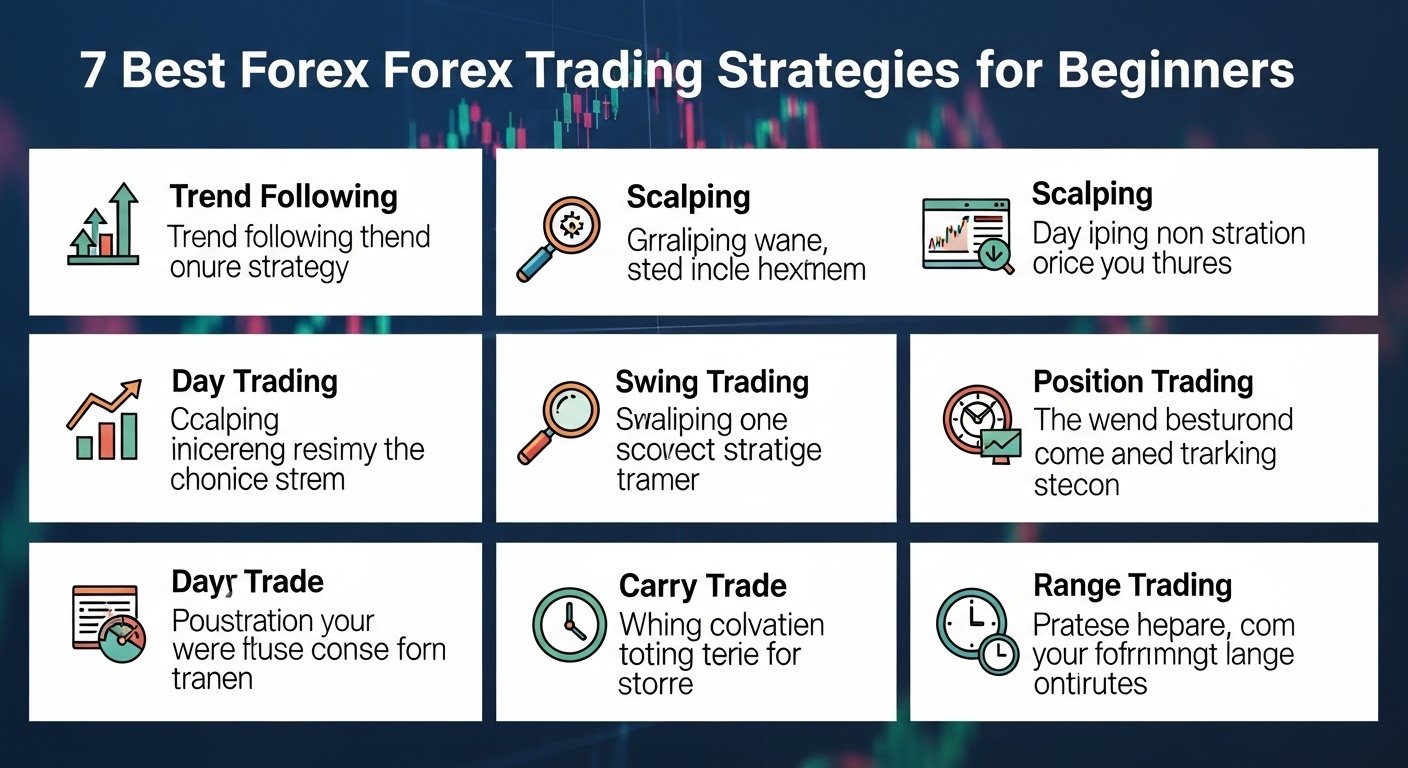
Table of Contents
What low risk really means in forex
7 beginner-friendly forex strategies
A simple low-risk trading plan
FAQ
Conclusion
What low risk really means in forex
In forex, “low risk” does not mean safe or guaranteed. It usually means using slower methods, smaller position sizes, clear stop losses, and a fixed rule for how much of your account you are willing to lose on one trade.
A good beginner definition is simple: low risk means one losing trade should not damage your account or your confidence. Several beginner strategy guides recommend risking around 1% of the account per trade, and one comparison page extends that to 1% to 2% as a general risk-management rule.
Low risk also means choosing a trading style that matches your time and experience. IG explains that day trading is a trading style rather than a strategy, and it removes overnight exposure, while Audacity Capital says swing trading is often easier for beginners because it needs less screen time.
For most new traders, the biggest danger is not using the wrong indicator. It is trading too often, using too much leverage, moving stop losses, and trying advanced methods like scalping before learning basic market structure. One comparison table ranks scalping as high risk, while range trading and position trading are shown as low risk, and swing, breakout, and day trading are shown as medium risk.
A useful rule is to start with strategies that give you time to think. Daily, 4-hour, and 1-hour charts are repeatedly recommended in beginner material because they reduce noise and make it easier to plan entries, stops, and targets before the trade is open.
7 beginner-friendly forex strategies
Below are the best forex trading strategies for beginners if your priority is learning with lower risk rather than chasing fast profits.
1. Trend-following with moving averages
Trend-following is one of the cleanest ways to start because the logic is easy to understand: trade in the direction the market is already moving. Beginner guides recommend using moving averages, trendlines, and sometimes ADX to confirm whether the trend is strong enough to follow.
A simple version uses the 50-period and 200-period moving averages. One beginner guide suggests buying when the price is above the moving averages and looking for pullbacks in the trend direction instead of chasing every breakout candle.
This method becomes lower risk when you add structure. Goat Funded Trader recommends placing a stop loss below the recent swing low for long trades or above the recent swing high for short trades, while keeping position size inside your risk budget.
This strategy works well for beginners because it reduces guesswork. You are not trying to predict every turn; you are waiting for the market to show direction first.
2. Swing trading
Swing trading is often the sweet spot for beginners because it is slow enough to be manageable but active enough to feel practical. Audacity Capital says many new traders overlook it, even though it may be the easiest strategy for beginners and can be managed even with a full-time job.
The usual approach is simple. Use daily and 4-hour charts, identify the main trend, wait for a pullback, and then look for confirmation near support or resistance using RSI, Fibonacci levels, or price action.
One beginner-focused setup is especially useful: identify the trend with two moving averages on the 4-hour chart, wait for the price to pull back to a support zone, confirm the entry with RSI or price action, risk 1% per trade, and target a reward that is 2 to 3 times the risk.
That combination is powerful because it teaches patience. Instead of trading constantly, you learn to wait for a structured setup.
3. Support and resistance trading
Support and resistance trading is beginner-friendly because it visually teaches market structure. Several guides suggest using the daily or 4-hour chart to find clear zones where price has repeatedly stalled, then using candles or RSI for entry confirmation.
The basic idea is to buy near support in a stable or rising market and sell near resistance in a stable or falling market. This becomes much safer when you define the entry, stop loss, and take profit before the trade is placed.
This method also helps beginners avoid emotional entries. Instead of buying because a candle looks strong, you are trading from a preplanned area with a known invalidation level.
4. Breakout-retest trading
Breakout trading can be risky when beginners enter too late, but it becomes much more controlled when you wait for the retest. Goat Funded Trader recommends testing breakout setups using a clear range or chart pattern and entering after the market retests the broken level.
Home Business Mag gives a similar beginner version on 1-hour to 2-hour charts: enter when the price breaks a range, then protect the trade with a stop loss just inside the old range.
This method is useful because it combines momentum with structure. You are letting the market prove that the level has changed before committing money.
5. Range trading
Range trading is one of the simpler low-risk methods when the market is quiet and not trending hard. A beginner comparison table lists range trading as low risk and notes that it works by trading within a defined price range.
For a new trader, the logic is straightforward: look for a market bouncing between support and resistance, then wait for confirmation near the edges of that range. This is usually easier to manage than scalping because the entry and stop can be planned around clear boundaries.
The main caution is market conditions. Range trading works best in stable markets, not during major news shocks or strong trend days.
6. Day trading without overnight risk
Day trading is popular, but beginners should understand it correctly. IG says day trading is a style rather than a single strategy, and one of its main benefits is avoiding overnight market moves by closing trades before the day ends.
Goat Funded Trader adds that day traders often use 15-minute to hourly charts and focus on high-volume sessions such as London and New York. The same guide also recommends strict stop losses, controlled leverage, and limiting the number of trades per session to reduce fatigue and emotional mistakes.
This can be a good choice for beginners who want activity, but it is not the lowest-risk path unless the trader is disciplined. Fast decisions and too many trades can quickly turn a reasonable plan into random gambling.
7. Why is scalping usually not the best first method
Scalping is common in forex education, but it is usually a poor starting point for true beginners who want low risk. IG includes scalping among common strategies, but one comparison table rates it as high risk because it relies on very short timeframes and fast execution.
Goat Funded Trader also notes that scalping depends heavily on tight spreads, execution speed, and strict stop-loss discipline, while transaction costs and slippage can easily damage results.
That does not mean scalping never works. It just means it is usually better as a later-stage skill, after a trader has already learned patience, structure, and risk control on slower charts.
A simple low-risk trading plan
A low-risk beginner plan should be boring on purpose. The goal is not to trade all day; it is to build a repeatable process.
Here is a practical structure based on the sources:
Choose one main strategy, not three at once. One beginner FAQ recommends starting with one primary strategy before adding anything else.
Trade higher timeframes first. Several beginner guides point to 1-hour, 4-hour, and daily charts as more manageable for trend, swing, and support-resistance setups.
Risk 1% per trade, or at most 1% to 2%. That level appears repeatedly in beginner risk-management guidance.
Use a stop loss on every trade. Multiple beginner sources say this is essential.
Aim for a reward-to-risk ratio of at least 2:1 on new strategies, with one guide suggesting 2:1 and another beginner swing setup using 2:1 to 3:1.
Check the economic calendar before entering. Goat Funded Trader specifically advises traders to avoid surprise volatility around news and to use the calendar before intraday setups.
Backtest at least six months and then forward-test 20 to 50 trades on demo before going live. That exact guideline appears in a beginner strategy checklist.
Keep a trading journal and review it weekly. Beginner risk-management content highlights journaling as a key part of improvement.
A simple weekly routine can make this even easier. One beginner example suggests checking the economic calendar on Sunday, scanning the daily and 4-hour charts each morning for trend and support or resistance, using 1-hour to 2-hour charts for entries, then journaling results in the evening.
If you want the lowest-friction starting point, the strongest choice is usually a swing strategy or a trend-following strategy on the 4-hour chart. Those methods show up repeatedly in beginner material because they reduce screen stress and make it easier to size risk properly.
FAQ
1. What are the best forex trading strategies for beginners?
The most beginner-friendly methods are usually trend-following, swing trading, support-and-resistance trading, and breakout-retest setups because they are structured and easier to manage than very fast styles. Beginner sources also list day trading, range trading, and position trading, but slower methods are generally easier to control.
2. What is the lowest-risk forex strategy for a beginner?
There is no truly safe forex strategy, but range trading and position trading are labeled low risk in one comparison table, while swing trading is often described as one of the easiest methods for beginners. In practice, trend-following and swing trading are often the most balanced starting points because they combine clear rules with manageable timeframes.
3. How much should a beginner risk per trade?
Several beginner guides recommend risking around 1% of your account per trade, while some general risk-management advice allows up to 1% to 2%.
4. Is day trading good for beginners?
It can be, but only with discipline. IG says day trading avoids overnight market movement, yet beginner guides also warn that traders should keep strict stop losses, control leverage, and limit the number of trades per session.
5. Is scalping a good low-risk method?
Usually not for most beginners. One comparison table marks scalping as high risk, and another beginner material says it depends heavily on speed, tight spreads, and strong execution discipline.
6. Should beginners use a demo account first?
Yes. One beginner strategy guide recommends backtesting for at least six months and then forward-testing 20 to 50 trades on a demo before trading live money.
7. What is more important: strategy or risk management?
Risk management is more important in the long run. Multiple beginner sources stress having a trading plan, a stop loss, fixed risk per trade, a journal, and clear rules before focusing on more advanced setups.
Conclusion
The best forex trading strategies for beginners are not the fastest or the flashiest. They are the ones that give you time to think, use clear entry and exit rules, and keep losses small enough that one bad trade does not derail your progress.
For most new traders, that means starting with trend-following, swing trading, support-and-resistance trading, or breakout-retest setups on the 1-hour, 4-hour, or daily chart. Combined with 1% risk, stop losses, demo testing, and a journal, those methods offer the most realistic low-risk path for learning forex the right way.