
What Affects Currency Prices? Inflation, Interest Rates Explained
If you have ever wondered what affects currency prices, the short answer is simple: currencies move when demand for them rises or falls. Exchange rates are the price of one currency compared with another, and that price changes as investors, businesses, banks, and central banks react to inflation, interest rates, trade flows, and economic confidence.
This matters in everyday life more than many people realize. Currency prices affect travel budgets, import costs, money transfers, inflation, and even how expensive foreign products feel at home, because exchange-rate moves can feed into domestic prices when imported goods become more costly.
The two drivers people hear about most are inflation and interest rates, and for good reason. High inflation usually reduces a currency’s purchasing power and hurts its competitiveness, while higher interest rates can attract foreign capital by offering better returns, which often supports the currency.
Still, the relationship is not mechanical. Markets sometimes push a currency higher on bad inflation data if traders think a central bank will respond with rate hikes, and sometimes a currency weakens even with high rates if political risk, debt concerns, or weak confidence outweigh the yield advantage.
In this guide, you will learn how supply and demand set the foundation, why inflation and interest rates matter so much, how central banks influence exchange rates, and what signals traders, businesses, and ordinary users should watch before exchanging money or making decisions in the forex market.
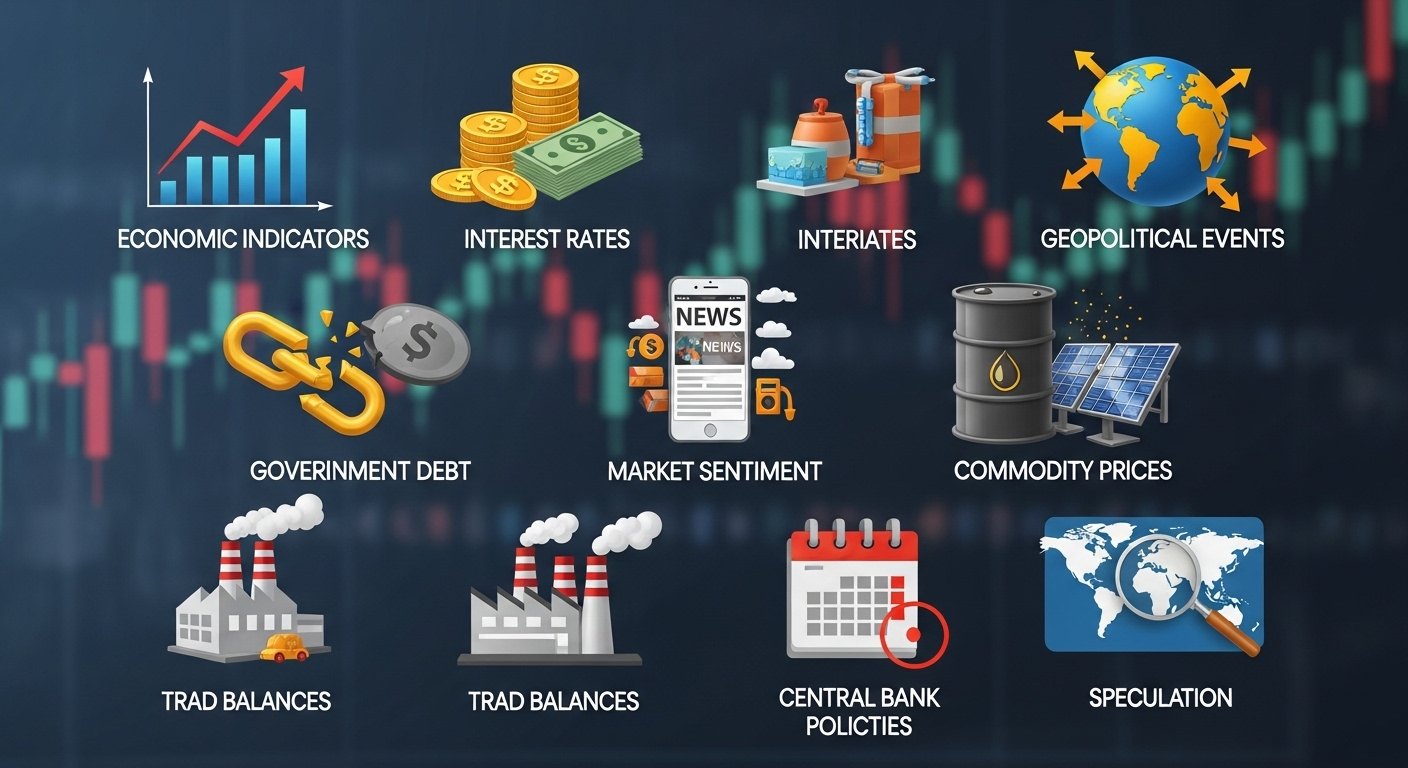
Table of Contents
Why currency prices move in the first place
How inflation changes the value of a currency
Why interest rates can strengthen or weaken currencies
How central banks shape exchange rates
What to watch in real life
FAQ
Why Currency Prices Move
At the most basic level, a currency rises when demand for it is stronger than supply, and it falls when supply is stronger than demand. Western Union’s exchange-rate explainer describes supply as the amount of a currency available to buy and demand as the level of interest in buying that currency.
Demand for a currency can rise for several reasons. Foreign investors may want to buy that country’s bonds or assets, importers may need the currency to pay for exports, or global markets may see the country as more stable and attractive than others.
Supply can rise for equally simple reasons. Residents of that country may be buying more foreign goods, investors may be moving money out, or easier monetary conditions may increase the domestic money supply and reduce the appeal of holding that currency.
This is why exchange rates can move even without dramatic headlines. A currency does not need a crisis to fall or a boom to rise; it only needs the balance between buyers and sellers to shift.
A helpful way to think about it is to imagine currencies as products in a global market. If more people want to own a currency because returns look attractive or the economy looks steady, its price tends to rise, and if fewer people want it, its price tends to fall.
The main drivers at a glance
For beginners, this table explains most exchange-rate moves better than complicated jargon does. If you can identify whether demand is rising or supply is rising, you are already closer to understanding what affects currency prices.
Inflation, Rates, and Central Banks
Inflation matters because it changes what a currency can actually buy. When inflation is high, the purchasing power of that currency tends to fall, and goods from that country may become less competitive compared with goods from countries where prices are more stable.
That weaker purchasing power often puts downward pressure on the currency. Privalgo explains that higher inflation can reduce demand for a country’s goods, and as those goods become less attractive, the value of the country’s currency may decline.
Low and stable inflation usually looks better to markets. It helps preserve purchasing power, supports confidence, and makes future returns easier to predict, which can be positive for the currency.
Interest rates matter because they change the reward for holding money in that currency. OANDA, WorldRemit, and Western Union all explain the same core idea: when rates rise, savings and bonds in that currency can become more attractive, which can pull in foreign capital and increase demand for the currency.
The reverse is also true. Lower rates make borrowing cheaper and saving less rewarding, which can reduce foreign investment demand and weaken the currency if other factors do not offset that effect.
This is why inflation and interest rates are so closely linked in foreign exchange markets. When inflation rises too fast, central banks often raise rates to cool demand and slow price growth, while lower inflation gives them more room to cut rates and support economic activity.
However, markets do not react only to today’s numbers. They also react to expectations, which is why a currency can sometimes rise on hot inflation data if traders believe a rate hike is now more likely. Privalgo notes that when inflation rises, markets can respond in two ways: the currency may strengthen if traders anticipate higher rates, or weaken if falling purchasing power becomes the dominant story.
That distinction is one of the most important lessons for beginners. Inflation itself often hurts a currency, but expected policy tightening can temporarily support it, especially when the market believes the central bank will act aggressively.
Central banks sit in the middle of this relationship. HSBC explains that central banks watch inflation closely when setting interest rates, and gives the example that if inflation rises too fast, they may raise rates to make borrowing more expensive and saving more attractive.
In floating exchange-rate systems, central banks do not always set the exchange rate directly. The Bank of England says it does not set the pound’s exchange rate, but its decisions can still influence the value of the currency indirectly through monetary policy.
They can also act more directly in some cases. Western Union explains that central banks hold foreign-currency reserves and can buy or sell currencies in the market to influence supply and demand, especially when they want to stabilize the exchange rate.
Monetary tools beyond standard rate changes matter too. Western Union notes that quantitative easing increases domestic money supply and lowers interest rates, which can reduce the appeal of the currency and put downward pressure on its value.
A final point that many readers miss is that exchange rates and inflation can affect each other both ways. Research summarized by the National Bureau of Economic Research says that when a currency depreciates, imported goods often become more expensive, and that can push domestic inflation higher, especially in countries where a large share of trade is priced in foreign currencies.
So the full picture is circular rather than one-directional. Inflation influences rates, rates influence capital flows, capital flows influence exchange rates, and exchange rates can feed back into inflation through import prices.
What to Watch
If your goal is to understand what affects currency prices in real time, focus on a few signals instead of trying to follow everything. The clearest ones are inflation data, interest-rate decisions, central-bank guidance, trade demand, and shifts in market confidence.
Here is a simple beginner-friendly framework:
Watch inflation reports first, because inflation is a major input into central-bank decisions and can move exchange rates immediately when the result is above or below expectations.
Watch interest-rate announcements and central-bank speeches next, because markets care not only about the current rate but also about the path of future policy.
Watch market confidence, because political instability, excessive debt concerns, or weak growth expectations can offset the positive effect of high rates.
Watch trade and competitiveness, because stronger export demand can increase demand for a currency while weaker competitiveness can reduce it.
Watch the exchange rate itself if you deal with imports or transfers, because currency weakness can raise import costs and make cross-border payments more expensive in inflationary periods.
A practical example makes this easier. Imagine inflation jumps unexpectedly in a country: the currency may fall because purchasing power is being eroded, but it may also rise for a while if traders believe the central bank will respond with faster rate hikes.
Now imagine rates do rise, but investors are still worried about politics or debt. In that case, the currency may fail to strengthen much because the yield advantage is being offset by lower confidence.
This is why simple one-line rules are useful, but never complete. “High rates strengthen a currency” is often true, and “high inflation weakens a currency” is often true, but markets are always pricing a mix of current conditions and future expectations.
Featured-snippet answer
If you want the shortest possible answer to the question “What affects currency prices?”, here it is:
Supply and demand set the basic price of a currency.
Inflation affects purchasing power and competitiveness, which usually influences the currency negatively when inflation is high.
Interest rates affect how attractive a currency is to investors, with higher rates often drawing in capital and supporting the exchange rate.
Central banks influence currencies through rate decisions, guidance, reserves, and monetary policy tools.
Trade flows, confidence, and political risk can strengthen or weaken a currency even when inflation and rates seem clear.
For travelers, importers, and small businesses, this framework is practical because it helps explain why rates can change before a transfer, after an inflation release, or right after a central-bank meeting.
For traders, it helps separate the data from the interpretation. A number only matters because of how it changes expectations about demand, supply, and policy.
FAQ
1. What affects currency prices the most?
Currency prices are mainly affected by supply and demand, but the biggest forces shaping that balance are inflation, interest rates, central-bank policy, trade flows, and investor confidence.
2. Does high inflation always weaken a currency?
Usually, high inflation weakens a currency because it reduces purchasing power and competitiveness. However, a currency can sometimes rise temporarily if markets think inflation will force the central bank to raise interest rates aggressively.
3. Why do higher interest rates often strengthen a currency?
Higher rates can attract foreign investors looking for better returns on savings, bonds, and other assets. That extra foreign demand often supports the currency and can push its exchange rate higher.
4. Do central banks directly set exchange rates?
Not always. In many floating systems, central banks influence exchange rates indirectly through interest rates and monetary policy, although they can also intervene with reserves in some situations.
5. Can exchange rates affect inflation,n too?
Yes. When a currency depreciates, imported goods usually become more expensive, and that can lift domestic inflation, especially in countries that rely heavily on foreign-currency trade.
6. What should beginners watch first?
Beginners should usually start with inflation releases, rate decisions, and central-bank guidance, because those events shape expectations about the future value of a currency more directly than most other headlines.
Conclusion: Currency prices move because global markets are constantly repricing supply, demand, inflation, interest rates, and confidence.
High inflation usually hurts a currency, higher interest rates often help it, and central banks connect those two forces by deciding when to tighten or loosen policy.
The smartest way to read any exchange-rate move is to ask three questions: has purchasing power changed, have rate expectations changed, and has market confidence changed.
That simple framework will help you understand what affects currency price c, es whether you are trading forex, sending money abroad, or just trying to exchange at a better rate.