
International bank transfers represent one of the most frequently utilized yet poorly understood financial services for businesses, expatriates, students, and families sending money across borders. The average cost of international wire transfers reaches approximately six percent of transferred amounts according to World Bank figures, yet many users remain unaware of the specific fees, exchange rate markups, and intermediary charges comprising this substantial total cost. Understanding the mechanics of international transfers, the various methods available, and proven strategies to minimize expenses enables you to save substantial amounts while ensuring reliable, timely delivery of funds across the globe.
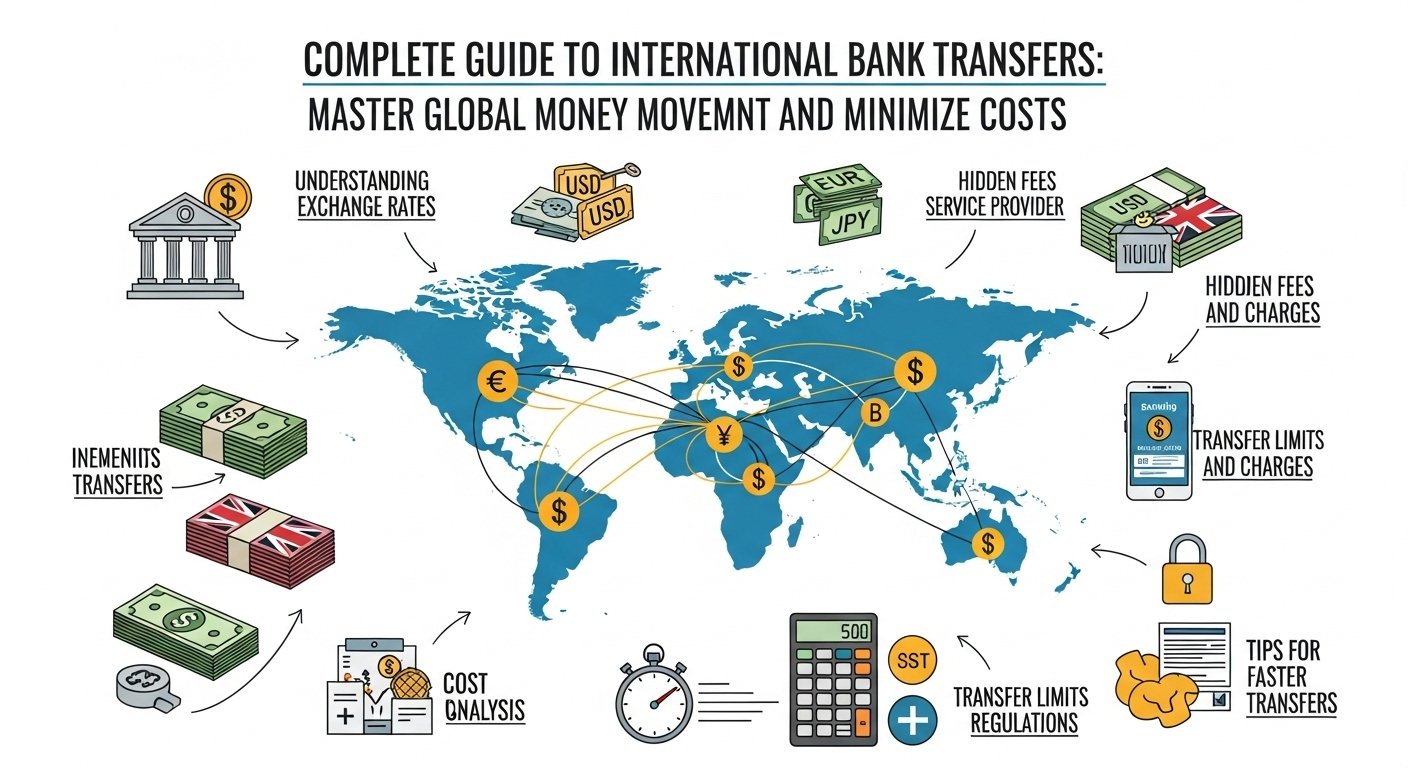
The international transfer landscape transformed dramatically in 2025 through technological advancement, enabling fintech platforms to compete directly with traditional banks through transparent pricing and superior exchange rates. Rather than accepting whatever fees your primary bank charges, modern money senders can compare dozens of options—from legacy SWIFT transfers to local payment rails to specialized money transfer platforms—each with distinct cost structures, speed characteristics, and suitability for different scenarios. This comprehensive guide examines every transfer mechanism, explains the complete cost breakdown, and reveals practical strategies enabling you to master global money movement while minimizing unnecessary expenses.
SWIFT Transfers: The Traditional International Banking Standard
SWIFT (Society for Worldwide Interbank Financial Telecommunication) represents the established international money transfer infrastructure connecting over 11,000 financial institutions across 220+ countries. SWIFT transfers remain the gold standard for international payments, particularly for large amounts, exotic currencies, or destinations lacking specialized payment corridors. Understanding SWIFT mechanics and associated costs proves essential for anyone regularly engaging in international transfers.
SWIFT transfers operate through a correspondent banking network, where your sending bank routes the payment through intermediary banks in other countries to reach your recipient’s bank. This multi-step process enables global reach but creates multiple opportunities for fees to accumulate as each intermediary bank extracts charges for processing. A single SWIFT transfer might pass through three or four intermediary banks—each deducting fees before passing the remaining funds to the next institution in the chain.
Complete SWIFT Fee Breakdown
The total cost of SWIFT transfers comprises multiple components that must be understood separately. The sending bank fee typically ranges from $25-$50, charged immediately when initiating the transfer. This flat fee covers the sending bank’s processing costs but remains charged regardless of transfer amount—making it more expensive as a percentage for small transfers and relatively minimal for large transfers.
Intermediary bank fees, also called correspondent bank fees, range from $10-$30 per intermediary bank. A transfer passing through two intermediary banks might incur $20-$60 in intermediary fees alone, deducted from the amount en route to your recipient, meaning they receive less than expected. The exact number of intermediary banks involved depends on routing efficiency, the currencies involved, and whether both endpoints are directly connected through correspondent relationships. You typically cannot predict the exact number of intermediaries, making the final recipient amount uncertain until transfer completion.
Receiving bank fees represent the third major component, typically $15-$25, charged by your recipient’s bank to process incoming international transfers. These fees are deducted from the transfer amount, further reducing what the recipient actually receives. Combined with sending bank fees and intermediary charges, receiving fees can total $50-$115 even before considering exchange rate effects.
Exchange rate markups represent the fourth hidden cost component, often overlooked but potentially exceeding all explicit fees combined. Banks typically mark up exchange rates by 2-5 percent above the real-time interbank rate. Sending $10,000 with a 3 percent markup loses $300 to exchange rate disadvantage alone—substantially more than the combined explicit fees. This markup occurs silently without conspicuous disclosure, making it the most insidious hidden cost in international transfers.
Real-world examples demonstrate the cumulative impact. A $10,000 transfer from Canada to the United States might cost: $50 sending bank fee + $15-$30 intermediary charges + $17.50 receiving bank fee + $300 exchange rate markup (3 percent) = $382.50 total cost, representing 3.8 percent of the transferred amount. The recipient would receive approximately $9,617.50 instead of the expected $10,000.
Local Payment Rails: The Hidden Cost-Reduction Opportunity
Local payment rails represent specialized payment corridors enabling direct transfers between countries without intermediary banks. Examples include SEPA (Single Euro Payment Area) for Eurozone transfers, Faster Payments System in the UK, ACH in the United States, and similar infrastructure in virtually every major country. These local rails provide dramatically lower costs, typically £0.30-£0.90 per transfer, compared to SWIFT’s $25-$50 range.
The critical advantage of local rails involves eliminating intermediary banks. When sending from the UK to another SEPA country, the payment transfers directly through the SEPA infrastructure without intermediate processing steps. This architectural simplicity translates directly to cost savings—fees on local rail transfers average 80-90 percent lower than equivalent SWIFT transfers. Transfers using local rails typically arrive within hours rather than the 1-3 business days required for SWIFT processing.
Local rail transfers work through receiving banks’ local account details. Rather than providing only a SWIFT/BIC code and IBAN, recipients can supply bank name, local account details, and routing information, enabling direct-to-bank transfers. Many specialized transfer platforms automatically route eligible transfers through local rails, requiring no additional action from users beyond selecting their recipient country.
The constraints involve geography—local rails only exist for connected countries within integrated payment systems. You cannot use SEPA to send to Australia or ACH to send to Singapore. Additionally, some banks and fintech platforms do not offer local rail access, restricting users to SWIFT-only options. Sophisticated money senders specifically choose platforms offering local rail access to minimize costs on regular international transfers.
Fintech Money Transfer Platforms: Technology-Driven Cost Efficiency
Specialized fintech platforms, including Wise, Remitly, OFX, and similar services, revolutionized international transfers through technology-driven operational efficiency and competitive market pressure, forcing fee reduction. These platforms typically charge transparent, published fees significantly lower than traditional banks—often £2-£7 per transfer—combined with exchange rates within 0.5 percent of interbank rates rather than the 2-5 percent markups charged by banks.
Wise exemplifies the fintech transfer revolution through its multi-currency holding infrastructure. Rather than routing transfers through correspondent banking networks, Wise maintains local bank accounts in over 80 countries. When you send to a Wise recipient in Japan, Wise immediately deposits your funds into their UK bank account (eliminating international transfer costs) while simultaneously withdrawing yen from their Japan account to deliver locally. This architectural approach eliminates intermediary banks, foreign exchange market exposure, and associated costs—delivering recipient funds at live interbank rates rather than marked-up bank rates.
Fintech platforms demonstrate particular advantages for regular transfers to the same destinations. Users sending monthly payments to family members abroad, freelancers receiving regular international payments, or small businesses maintaining supplier relationships internationally benefit tremendously from fintech platforms’ low fixed fees. A $500 transfer costing $50 through a bank ($10 sending fee + $25 receiving fee + $15 exchange markup) costs approximately $3-$5 through Wise, a 90 percent savings.
The tradeoff involves transaction limits and account verification requirements. Most fintech platforms impose daily/monthly transfer limits for new accounts, requiring identity verification and sometimes proof of funds source before enabling large transfers. Traditional banks impose no such restrictions on established customers. Additionally, fintech platforms sometimes offer limited service to high-risk jurisdictions where banks maintain broader (though costlier) capabilities.
Comparing Fintech Platform Cost Structures
Different fintech platforms employ different fee models requiring careful comparison. Wise charges variable fees (typically £2-£7) based on transfer size and currency pair, plus a small amount exchange rate margin (0.5 percent). Remitly charges fixed fees ($2-$20) plus exchange rate markups (1.5-2 percent). OFX charges percentage-based fees (1.5-2 percent), creating higher-cost profiles for large transfers. For a $5,000 transfer to the Eurozone, Wise typically costs £3-5, while Remitly might cost $25-50, depending on the payment method selected. The comparison requires checking actual rates when making transfers rather than relying on published fee schedules.
Money Transfer Operators: Cash Pickup and Mobile Delivery
Traditional money transfer operators, including Western Union and MoneyGram, provide extensive global networks for cash pickup and digital wallet delivery. These services prove particularly valuable for recipients in developing countries lacking bank accounts, enabling fund access through local pickup locations within hours of sending. Cost structures typically involve percentage-based fees (3-5 percent) plus exchange rate markups (2-4 percent), resulting in total costs comparable to bank SWIFT transfers but with dramatically faster delivery.
Money transfer operators particularly serve consumer remittances—individuals sending modest amounts to family members—rather than business-to-business transfers. The extensive physical network (Western Union operates in 180+ countries through 500,000+ locations) provides accessibility unavailable through banks or fintech platforms in less-developed markets. The convenience of cash pickup within hours justifies the higher percentage fees for individuals prioritizing speed and local currency access over minimum cost.
Currency Exchange Considerations: The Hidden Cost Multiplier
Currency exchange represents the least obvious yet potentially largest transfer cost component. When sending $10,000 to Europe, the exchange rate applied fundamentally affects how many euros your recipient receives. The interbank spot rate—the actual market rate at which banks trade currencies—changes constantly, moving fractions of a penny per second. This real-time rate represents the “true” exchange rate in an economically pure sense.
However, financial institutions don’t offer interbank rates to customers. Instead, they apply markups—typically 2-5 percent for banks, but as low as 0.5-1 percent for fintech platforms. A $10,000 USD to EUR transfer at a 3 percent bank markup versus a 1 percent fintech markup creates a €400 difference (approximately $430 USD) in what the recipient receives. This exchange rate differential alone exceeds the combined explicit fees charged by either provider.
For time-sensitive transfers, exchange rate movements create additional considerations. Sending €10,000 to the UK when EUR/GBP trades at 0.83 yields £8,300. But if the exchange rate moves to 0.81 before your transfer completes, the same €10,000 yields only £8,100—a £200 loss due to currency appreciation. Conversely, favorable rate movements could increase received amounts. Forward contracts enable locking in specific exchange rates for future transfers, eliminating uncertainty but potentially foregoing favorable rate movements.
Practical Strategies to Minimize International Transfer Costs
Strategic decision-making reduces international transfer expenses substantially. For regular transfers to the same destination, establishing accounts with fintech platforms offering local payment rails delivers cost savings exceeding 80-90 percent versus traditional bank SWIFT transfers. A business sending monthly €5,000 payments saves €100-150 monthly (€1,200-1,800 annually) by switching from bank to fintech platforms—a meaningful amount justifying account establishment and payment process modifications.
Consolidating transfers reduces costs through fixed-fee amortization. Rather than sending ten $1,000 transfers incurring fixed fees of approximately $500-600 total, consolidating into a single $10,000 transfer incurs identical fixed fees—a 90 percent savings on a per-dollar basis. Businesses with flexibility in payment timing can batch transfers monthly rather than sending weekly payments, reducing the aggregate fee burden substantially.
Timing transfers around favorable exchange rate movements eliminates transfer costs through superior rate capture. A business expecting to receive €100,000 revenue can electronically transfer the full amount immediately upon receipt rather than delaying for better rates—but when receiving $50,000 annually, strategic timing around 50-100 pip (0.0050-0.0100) EUR/USD movements creates natural rate optimization without requiring active currency speculation. Monthly rebalancing of international investment portfolios enables similar timing flexibility.
Understanding receiving bank requirements prevents unnecessary fees. Some banks charge substantially lower fees for deposits meeting specific criteria—transfers exceeding certain minimums, transfers received via local payment rails versus SWIFT, or transfers specifically identified as business payments versus personal remittances. Communicating transfer details accurately enables recipients to route payments efficiently, minimizing intermediate processing steps and associated fees.
Estimated Transfer Costs: Real-World Examples
Understanding typical costs across different scenarios guides decision-making. A $1,000 transfer from the United States to Australia costs approximately: Traditional Bank $45 sending fee + $50 SWIFT charge + $15 receiving fee + $30 exchange markup (3%) = $140 total (14% of amount). Fintech Platform $5 fee + $5 exchange margin (0.5%) = $10 total (1% of amount). The fintech savings exceed $130 on a single $1,000 transfer.
A €50,000 transfer from Germany to France via SEPA local rail costs €0.30 versus €35+ for SWIFT, saving €34.70+ on the transfer plus eliminating intermediary bank deductions. For recurring business payments, this €34.70 per-transfer savings accumulates to €400+ annually on just monthly payments. The local rail efficiency also delivers same-day processing rather than 2-3 business day delays, enabling faster cash management.
A $100,000 transfer from the United States to Singapore demonstrates dramatic cost differences across methods. Traditional SWIFT: $50 sending fee + $50+ in intermediary charges + $25 receiving fee + $3,000 exchange markup (3%) = $3,125 total (3.1%). Fintech platform offering local rails: $10 fee + $500 exchange margin (0.5%) = $510 total (0.51%). The fintech savings reach $2,615 on a single large transfer—exceeding the cost of establishing accounts and payment processes.
Hidden Fees and Deductions: What to Anticipate
Intermediary bank deductions represent the most treacherous hidden cost. Your sending bank states, “Transfer complete – $10,000 sent,” but the recipient receives only $9,875 because intermediary banks deducted $125 in processing fees. This discrepancy frustrates both sender and recipient—you believed you sent $10,000, the recipient expected $10,000, but intermediary fees reduced the received amount. When instructing transfers, always specify whether the amount represents “send exactly $10,000” (meaning intermediary fees reduce the received amount) or “recipient receives $10,000” (meaning you send more to compensate for fees).
Cancellation and amendment fees create additional expenses for transfer modifications. Changing recipient details, requesting priority processing, or canceling pending transfers typically costs $25-75 per change. Transfer reversals due to incorrect details can incur additional $100+ fees as the receiving bank must reverse and your sending bank must re-initiate. Careful verification before submitting transfers prevents these expensive modifications.
Timing and Processing Speed Expectations
Transfer speed varies dramatically across methods. Local payment rail transfers typically complete same-day, with most Eurozone SEPA transfers arriving within 1-2 hours. SWIFT transfers conventionally require 2-3 business days, though expedited SWIFT variants cost more for next-day delivery. Fintech platforms usually match SWIFT speed for large transfers but offer instant delivery for local rail-eligible transfers.
Weekend and holiday processing represents an often-overlooked timing factor. Transfers initiated on Friday afternoon might not process until Monday, then require additional days to settle. Transfers initiated just before country-specific holidays experience extended delays as receiving-side infrastructure shuts down. Strategic timing around business day schedules minimizes processing delays for transfers requiring urgency.
Security and Fraud Protection Considerations
International transfers involve substantial fraud risk—unlike domestic transfers easily reversible within days, international transfers often become irreversible once reaching intermediary banks. Criminals exploit this finality by tricking senders into transferring funds for fake purchases or fictitious business opportunities. Verifying recipient details through independent channels before transferring large amounts prevents costly mistakes.
Established fintech platforms and major banks implement robust fraud detection, though this protection comes at the cost of sometimes-frustrating security requirements. Account freezes, transfer delays for verification, and identity confirmation requests cause temporary inconvenience but prevent fraudulent transfers, protecting both the platform and users. Cooperating with platform security requirements—providing documentation, responding to verification inquiries promptly—facilitates smooth transfers.
Tax and Regulatory Implications
International transfers trigger tax and regulatory reporting requirements in many jurisdictions. United States citizens face mandatory FATCA reporting for foreign financial accounts exceeding $10,000. Many developed countries impose similar reporting obligations. Large international transfers from businesses can trigger money laundering investigation protocols, requiring documentation demonstrating transfer legitimacy. Maintaining records of transfer purposes, invoice documentation, and business justification streamlines regulatory compliance.
Conclusion: Master International Transfers and Minimize Unnecessary Costs
International bank transfers represent an essential yet costly mechanism for global money movement, with typical costs reaching 3-6 percent of transferred amounts when combining explicit fees, intermediary charges, and exchange rate markups. Understanding the complete cost structure—distinguishing between sending fees, intermediary charges, receiving fees, and exchange rate markups—enables strategic optimization, eliminating unnecessary expenses. Fintech platforms offering local payment rails deliver 80-90 percent cost reductions compared to traditional bank SWIFT transfers for compatible routes, justifying account establishment for regular international transfers.
Strategic consolidation, timing optimization, and route selection transform international transfers from costly, frustrating experiences into efficient financial operations. Whether you’re an expatriate supporting family members abroad, a business maintaining international supplier relationships, or an investor managing cross-border portfolios, mastering international transfer mechanics and costs generates substantial long-term savings. Evaluate your specific transfer patterns, compare available options using real rate quotes rather than published fee schedules, and commit to the platform and methods delivering the lowest total cost for your typical transfers. Your financial bottom line depends on making informed decisions about how you move money globally.