
How to Read Forex Charts (Candlesticks, Trends, Indicators)
Reading forex charts can feel confusing at first because you are looking at fast-moving price data, colored candles, lines, and patterns that seem random. Yet beginner chart guides explain that once you understand candle structure, trend direction, support and resistance, and a few basic indicators, the chart starts to look less like noise and more like a visual record of market psychology.
That is why this topic matters so much for new traders. Effective chart reading helps traders identify trends, spot possible reversals, find better entry and exit areas, and manage risk with more confidence instead of trading on emotion alone.
This guide explains how to read forex charts in a practical way for beginners. You will learn what a candlestick shows, how to tell whether the market is trending or consolidating, how to read key candle patterns, and how to use beginner-friendly indicators without turning your chart into a mess.
Table of Contents
What a forex chart is really showing
How to read candlesticks
How to spot trends and key levels
Which indicators should beginners use
FAQ
Conclusion
What a Forex Chart Shows
A forex chart is simply a visual display of how one currency pair has moved over time. Candlestick charts are widely used because each candle shows the opening price, highest price, lowest price, and closing price for a chosen time period, whether that period is one minute, one hour, or one day.
That extra detail is what makes candlestick charts more powerful than line charts for many traders. One beginner guide explains that line charts only show closing prices, while candlesticks reveal the entire battle between buyers and sellers during the session.
The first mistake many beginners make is zooming in too fast. A strong chart-reading habit is to zoom out first and study the overall landscape so you can see whether the price is generally climbing, falling, or moving sideways before worrying about a single candle.
This matters because the same candle can mean different things in different places. A bullish-looking candle inside a strong downtrend does not automatically mean the market has reversed, and a doji near a major resistance area can carry a very different message than a doji in the middle of a quiet range.
Once you understand that idea, chart reading becomes much easier. You stop asking, “What does this one candle mean?” and start asking, “What is this candle saying inside the bigger picture?”
How to Read Candlesticks
Every candlestick has three main parts that beginners should understand first: the body, the wick, and the close position. A strong candlestick guide explains that body size helps show conviction, wick length can show rejection, and where the candle closes within its range gives a clue about who controlled the period.
A large body with short wicks often shows that one side was dominant for most of the session. A very small body with long wicks, such as a doji or spinning-top style candle, usually signals indecision because buyers and sellers both pushed the price, but neither side truly took control.
Here is the simplest way to read a candle:
A long bullish body usually shows strong buying pressure.
A long bearish body usually shows strong selling pressure.
A long upper wick can show that price was pushed higher,r but sellers forced it back down, which may hint at resistance or fading bullish momentum.
A long lower wick can show that price was pushed lower, but buyers stepped in before the close, which may hint at support or rejection of lower prices.
A tiny body often signals hesitation, balance, or indecision rather than clear control.
That is why experienced traders rarely judge candles by color alone. Two green candles can look similar at first glance, but one may close near its high with strong conviction, while another may have a long upper wick that shows the move was rejected before the session ended.
High-value candlestick patterns
Some patterns matter more because they show a shift in control between buyers and sellers. The most common beginner-friendly examples mentioned in charting guides include the doji, hammer, shooting star, engulfing patterns, morning star, evening star, three white soldiers, and three black crows.
A hammer has a small body near the top of the candle and a longer lower wick, which can suggest that sellers drove the rice down, but buyers pushed it back up before the close. A shooting star is the opposite shape near the top of an uptrend, where early buying fades,s and sellers take control into the close.
An engulfing pattern is also important because it shows one candle fully overtaking the body of the previous candle. A bullish engulfing pattern happens when a green candle fully covers the body of the previous red candle, while a bearish engulfing pattern does the reverse and can warn that momentum has shifted downward.
Three-candle patterns can carry even more weight because they tell a clearer story. A morning star may signal a possible bottom after a downtrend, while an evening star can mark a possible top after an uptrend.
Momentum patterns matter too. Three White Soldiers shows three strong bullish candles advancing in sequence, while Three Black Crows shows the bearish version with repeated strong closes lower.
Still, the best lesson for beginners is not to memorize shapes mechanically. Good charting guides stress that the same pattern means more when it appears at a support zone, resistance zone, or key turning point than when it appears randomly in the middle of nowhere.
How to Spot Trends and Key Levels
Trend reading is the foundation of forex chart analysis because candles make more sense when you know the direction of the broader move. One complete candlestick guide recommends first asking whether the chart is in an uptrend, a downtrend, or a consolidation before interpreting individual signals.
A basic uptrend usually shows price pushing higher overall, while a downtrend shows price moving lower overall. Consolidation means the price is moving sideways, and neither buyers nor sellers have clear control for the moment.
Support and resistance are the next pieces of the puzzle. When the price keeps hesitating or bouncing from the same area, that zone can become a support floor or a resistance ceiling where buyers and sellers have already fought before.
These levels matter because candles become more meaningful there. A long lower wick near support can show rejection of lower prices, while a shooting star or bearish candle near resistance can warn that buyers are losing strength.
This is why context beats pattern memorization. A bearish candle with a long upper wick inside a resistance zone can be a stronger warning signal than the same candle appearing in the middle of a trend with no nearby level.
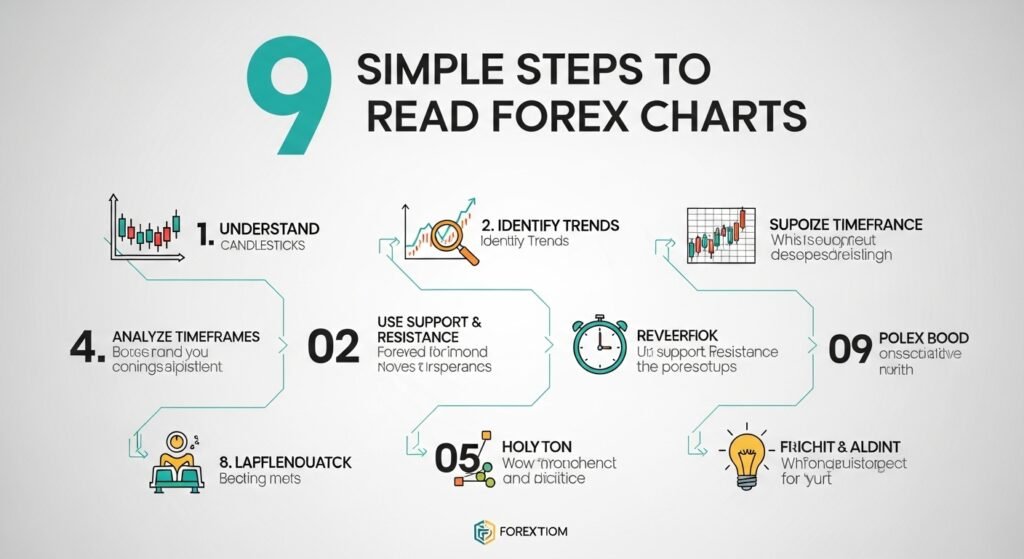
A practical beginner method is to follow this order:
Zoom out and identify the bigger trend first.
Mark support and resistance are where the price repeatedly stalls or reverses.
Wait for candles to react at those areas instead of trading in random parts of the chart.
Read the candle body, wick, and close to judge conviction or rejection.
Use a simple indicator only after price action already makes sense.
This approach helps reduce one of the biggest beginner problems: forcing trades from isolated candles. Charts become much clearer when you combine trend, level, and candle behavior instead of treating each signal as a complete trading system by itself.
Continuation vs reversal
Not every pattern means the market is about to turn around. IG explains that some candlestick patterns are continuation patterns, which means they show a pause or a period of indecision before the original trend resumes.
That distinction is important because many beginners see any strange-looking candle and assume a reversal. In reality, a market can pause, compress, and then continue strongly in the same direction, which is why traders need confirmation instead of guessing.
A good rule is to let price confirm the story. One trading guide notes that bilateral or indecision-style formations should not be forced into a prediction, and traders are better served by preparing for both directions and letting price reveal the real breakout.
Which Indicators Beginners Should Use
Indicators should support chart reading, not replace it. Beginner materials around candlestick and chart analysis repeatedly point back to price action, trend, support, and resistance as the core, while indicators are used to add structure and confirmation.
For most beginners, fewer indicators work better than many indicators. Adding too many tools can create conflicts, slow decisions, and hide the simple message already visible in the candles themselves.
1. Moving averages
A moving average is one of the easiest indicators to start with because it smooths the price and helps show the general direction of the market. In one chart-reading example, a nine-period moving average was used as a support area where the price dipped, found support, and then rallied again.
That makes moving averages useful for two beginner tasks. First, they help you see trend direction more clearly, and second, they can help you notice dynamic support or resistance areas where price repeatedly reacts.
A simple beginner rule is to avoid treating a moving average like magic. It is better used as a guide for context than as a signal to buy or sell without reading the candles around it.
2. Fibonacci retracement
Fibonacci retracement is another common beginner tool when the market is already trending. One forex candle lesson explains that after an upward trend and a retracement, traders often watch the 50, 61.8, and 78.6 retracement areas for possible buy opportunities if the price shows confirmation there.
This is useful because it teaches patience. Instead of buying after a sharp move, the trader waits for the price to pull back into a known area and then studies the candle behavior before entering.
Fibonacci levels work best when they line up with something else, such as trend direction, a support zone, or a strong rejection candle. Used alone, they are just levels on a chart, but used with context, they can become a helpful decision-making framework.
3. Candles first, indicators second
The most valuable beginner mindset is simple: read price first, then use indicators to refine the idea. The charting sources here repeatedly emphasize trend direction, neighboring candles, support and resistance, and candle structure before moving on to more advanced tools.
That is also the safer path for new traders. One detailed guide says patience and waiting for high-probability setups with clear candlestick confirmation serve traders better than forcing trades from incomplete patterns or relying on complicated systems.
FAQ
1. What is the easiest way to read forex charts?
The easiest method is to zoom out first, find the overall trend, mark support and resistance, and then read individual candlesticks in those areas. That process is recommended because the same pattern can mean different things depending on the bigger chart context.
2. What does a candlestick show?
A candlestick shows the open, high, low, and close for a selected time period. This makes it more informative than a line chart, which mainly shows closing prices.
3. What is the difference between the candle body and the wick?
The body shows the distance between the open and close, while the wick shows how far the price moved beyond that body during the period. Chart guides say body size often reflects conviction, while wick length can reflect rejection or failed price movement.
4. Which candlestick patterns should beginners learn first?
Beginners usually benefit most from learning the doji, hammer, shooting star, engulfing patterns, morning star, evening star, Three White Soldiers, and Three Black Crows. These patterns are commonly highlighted because they help show indecision, reversal pressure, or momentum.
5. How do I know if the market is trending?
Start by zooming out and checking whether the price is generally climbing, falling, or moving sideways. A moving average can help confirm direction, but the broader chart structure should come first.
6. Which indicator is best for beginners?
A moving average is one of the easiest indicators for beginners because it helps smooth the price and can highlight trend direction or dynamic support and resistance. Fibonacci retracement can also be useful after a trend, but only when it is combined with clear candle confirmation.
Conclusion
The best way to learn how to read forex charts is to keep the process simple: start with the trend, mark important levels, read candle structure carefully, and use only a small number of indicators for confirmation.
Candlesticks matter because they reveal more than direction alone. They show conviction, hesitation, rejection, and the constant struggle between buyers and sellers through the body, the wick, and the close.
Trends matter because candle patterns are only meaningful in context. Indicators matter because they can support your decision, but they work best when price action already makes sense before you add them.
A beginner who learns to zoom out first, respect support and resistance, and wait for clear candle confirmation already has a stronger foundation than someone using ten indicators without understanding what the chart is saying.