
The international monetary system relies on different exchange rate regimes, determining how currencies are valued relative to each other. Each regime employs distinct mechanisms, offers different advantages and disadvantages, and produces vastly different outcomes for international trade, investment, and monetary policy effectiveness. Understanding these three primary exchange rate systems—fixed, floating, and managed—proves essential for comprehending global financial dynamics, currency market behavior, and national economic policies.
Fixed Exchange Rate System: Definition and Mechanics
What is a Fixed Exchange Rate?
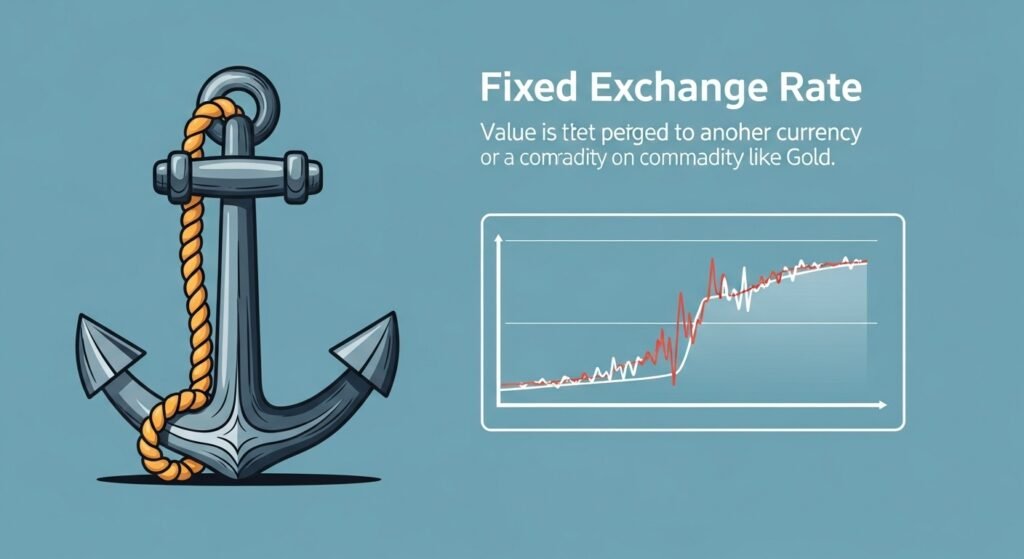
A fixed exchange rate system, also called currency pegging, establishes and maintains a predetermined value relationship between two currencies. The central bank publicly announces a fixed rate and commits to defending it through unlimited buying and selling of its own currency at that rate.
For example, the Saudi Riyal maintains a fixed peg to the US Dollar at 3.75 SAR per 1 USD. The Saudi Central Bank actively manages this relationship, buying and selling riyals to maintain the exact peg rate. This commitment proves absolute—the central bank stands ready to execute unlimited transactions sustaining the fixed ratio.
Historical Examples
Denmark pegs the Danish Krone to the Euro. China previously maintained a fixed peg to the US Dollar before transitioning to managed floating in 2005. The Bretton Woods system, operating from 1944 to 1971, represented global fixed exchange rates where all currencies were pegged to the US Dollar, which itself was pegged to gold.
How Central Banks Maintain Fixed Rates
Central banks employ open market operations, buying and selling domestic and foreign currencies, maintaining the peg. When domestic currency appreciation pressure emerges, the central bank sells its own currency and buys foreign currency, increasing supply and restraining appreciation.
Conversely, when depreciation pressure threatens, the central bank buys its own currency using foreign exchange reserves, increasing demand and supporting valuations.
These operations require substantial foreign exchange reserves. Central banks must maintain reserves sufficient for potentially years of maintaining the peg against persistent market pressure.
Advantages of Fixed Exchange Rate Systems
Stability and Predictability
Fixed rates eliminate short-term exchange rate volatility, providing certainty for international businesses. Companies planning long-term investments know exactly what currency exchange rates will apply, enabling confident pricing and investment decisions.
Reduced Hedging Costs
With exchange rates fixed, businesses do not require expensive hedging instruments to protect against currency fluctuations. This reduces transaction costs and financial complexity for international commerce.
Control of Inflation
Fixed rates anchor monetary policy, constraining inflationary expansion. When a currency pegs to a low-inflation anchor like the US Dollar, the pegging country imports the anchor nation’s monetary credibility.
Trade Facilitation
Predictable exchange rates simplify international trade. Exporters and importers can confidently plan production and pricing without currency shock risks.
Investor Confidence
Fixed rates provide security, attracting foreign investors comfortable with predictable currency valuations.
Disadvantages of Fixed Exchange Rate Systems
Loss of Monetary Policy Independence
Fixed-rate commitments constrain monetary policy. Central banks cannot independently adjust interest rates without threatening the peg. If a country wants stimulative rate cuts but its anchor currency maintains high rates, the pegging country cannot follow without triggering depreciation.
Limitations During Economic Shocks
When economies suffer external shocks requiring a monetary response, fixed rates prevent appropriate adjustment. Countries cannot devalue currencies to improve export competitiveness when facing a recession.
Reserve Requirements
Maintaining fixed rates demands enormous foreign exchange reserves. These reserves—often billions of dollars—represent opportunity costs. Reserves could alternatively finance productive investments instead of defending currency pegs.
Speculative Attacks
When markets doubt a peg’s sustainability, massive speculative selling attacks central banks. The 1997 Asian Financial Crisis involved devastating speculative attacks against fixed rates. Thailand exhausted its foreign reserves defending its peg, eventually abandoning it after enormous losses.
Imbalance Accumulation
Fixed rates prevent the automatic adjustment mechanism from correcting trade imbalances. Countries with persistent trade deficits cannot devalue to reduce import demand, instead accumulating ever-growing deficits.
Floating Exchange Rate System: Definition and Mechanics
What is a Floating Exchange Rate?
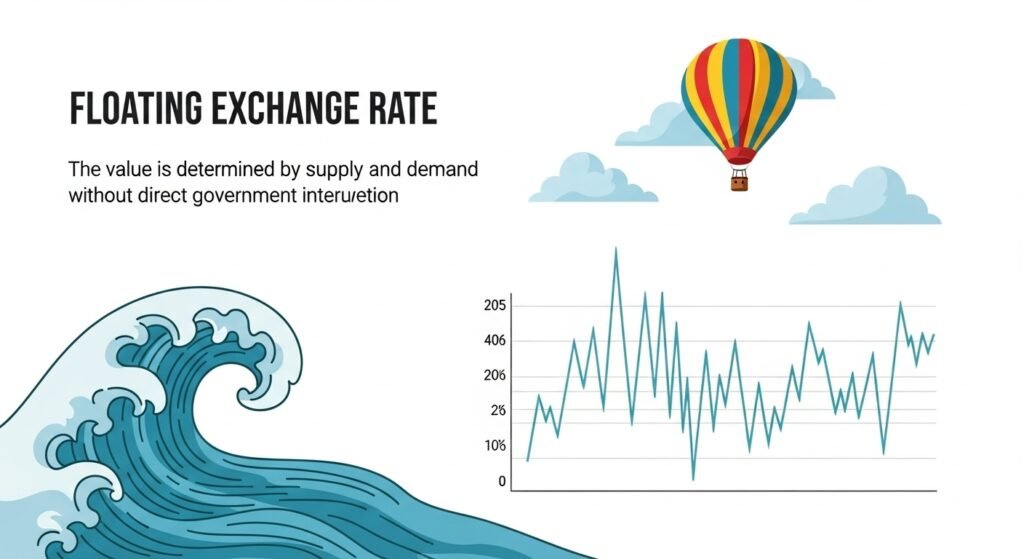
Floating exchange rate systems allow currencies to be valued based on open market supply and demand without central bank intervention. Exchange rates fluctuate continuously, reflecting changing economic conditions, interest rate differentials, capital flows, and investor sentiment.
Most major developed economies, including the United States, the European Union, Japan, and the United Kingdom, operate floating exchange rate regimes.
Market Determination Process
In floating systems, buyers and sellers meet in the currency market, determining equilibrium prices through normal trading interactions. No government or central bank announces rates or commits to specific values.
Examples of Floating Regimes
The US Dollar floats freely against major currencies. The Euro floats, reflecting supply and demand across Eurozone financial markets. The Japanese Yen floats based on global trading activity.
Advantages of Floating Exchange Rate Systems
Monetary Policy Independence
Central banks pursue independent monetary policies without defending specific exchange rates. The US Federal Reserve adjusts rates purely to address domestic inflation and employment without currency peg constraints.
Automatic Adjustment Mechanism
Exchange rates adjust automatically, responding to economic changes. When a country’s economy weakens, currency depreciation improves export competitiveness through cheaper prices, supporting growth recovery.
No Reserve Requirements
Floating rates eliminate massive foreign exchange reserve maintenance costs. Central banks can deploy reserves toward productive investments instead of currency defense.
Immunity to Speculative Attacks
Without fixed rates to attack, speculators cannot exhaust reserves through targeted selling. Floating currencies simply depreciate against selling pressure without requiring reserve depletion.
Economic Efficiency
Floating rates enable efficient capital allocation. Investment flows automatically direct toward the highest-return opportunities without artificial rate constraints.
Disadvantages of Floating Exchange Rate Systems
High Volatility and Unpredictability
Floating rates fluctuate substantially based on economic announcements, political events, and sentiment changes. This volatility creates uncertainty for international businesses unable to confidently predict exchange rates.
Hedging Costs
Businesses operating internationally must purchase expensive hedging instruments to protect against currency fluctuations. These costs reduce profit margins and competitiveness.
International Trade Complications
Exporters cannot confidently determine pricing when exchange rates fluctuate. Companies may receive significantly less revenue than anticipated when receiving payments in weakened currencies.
Speculation and Manipulation Risks
Currency speculators can trigger volatility unrelated to fundamental economic conditions. Excessive speculation disconnects exchange rates from economic fundamentals, creating instability.
Inflationary Pressures
Currency depreciation increases import prices, translating into domestic inflation. Countries experiencing significant depreciation face elevated inflation regardless of monetary policy intentions.
Managed Floating Exchange Rate System: Definition and Mechanics
What is a Managed Floating Exchange Rate?
Managed floating, also called “dirty float,” combines elements of both fixed and floating systems. Currencies float within predetermined bands, with central banks intervening when rates threaten to exit the corridor.
The central bank neither totally fixes the rate nor abandons it entirely to markets. Instead, it maintains a “target corridor” or “band” within which the currency fluctuates freely, but outside which it intervenes.
China’s Managed Float Example
China employs the world’s most significant managed floating system. Each trading day begins with the Chinese Central Bank announcing a “reference rate,” then permitting the renminbi to fluctuate ±2% from this rate.
This arrangement provides stability within the band while allowing gradual adjustment as underlying conditions change. The band prevents both excessive appreciation and depreciation while retaining some flexibility absent in pure fixed systems.
Thailand’s Managed Float
Thailand adopted a managed float exchange rate regime to stabilize exchange rates while limiting volatility, enabling the baht to reflect economic fundamentals. The Bank of Thailand intervenes in purchasing or selling currency, maintaining the target corridor.
Central Bank Intervention Mechanics
When managed float currencies approach band boundaries, central banks buy or sell to keep rates within corridors. This targeted intervention differs from fixed rates requiring unlimited support.
Advantages of Managed Floating System
Flexibility with Stability
Managed floats provide stability within bands while retaining flexibility for gradual adjustment. Long-term trends influence rates while short-term volatility remains contained.
Reduced Reserve Requirements
Compared to pure fixed systems, managed floats require smaller foreign exchange reserves. Bands provide flexibility, reducing intervention frequency.
Monetary Policy Flexibility
Managed floats allow greater monetary policy independence than pure fixed rates while maintaining more stability than pure floats.
Economic Fundamentals Reflection
Rates gradually aadjustreflecting underlying economic changes within band constraints.
Speculative Attack Resilience
The established corridor reduces speculative attack vulnerability. Speculators cannot easily force rates beyond defended bands.
Disadvantages of Managed Floating System
Complexity and Credibility Requirements
Managed systems require credible central banks with substantial reserves. Insufficient credibility invites speculative attacks exploiting doubts about corridor defense.
Band Selection Challenges
Establishing appropriate bands proves difficult. Bands too narrow resemble fixed rates, requiring excessive intervention. Bands too wide provide little stability benefit.
Potential Market Distortion
Frequent intervention can distort market efficiency, preventing natural price discovery.
Intervention Visibility
Persistent intervention attracts criticism and speculation regarding sustainability. Markets may question whether central banks genuinely control bands.
Comparative Analysis: Fixed vs. Floating vs. Managed
| Characteristic | Fixed Rate | Floating Rate | Managed Float |
|---|---|---|---|
| Exchange Stability | Extremely stable | Highly volatile | Moderately stable |
| Central Bank Intervention | Constant | Minimal/none | Periodic within bands |
| Monetary Policy Freedom | Constrained | Maximum | Moderate |
| Reserve Requirements | Massive | Minimal | Moderate |
| Trade Predictability | Excellent | Poor | Good |
| Speculative Attack Risk | High | Low | Moderate |
| Economic Adjustment | Sluggish | Automatic | Gradual |
| Capital Mobility | Limited | Maximum | Moderate |
| Business Planning Ease | Simple | Complex | Moderate |
Global Distribution of Exchange Rate Regimes
Fixed and Pegged Systems
Saudi Arabia (USD peg), Denmark (Euro peg), Hong Kong (USD peg), and various other nations employ fixed pegs. These typically include smaller economies or those integrated within larger economic blocs.
Floating SysteThe ms
United States, the European Union, Japan, the United Kingdom, Canada, Switzerland, and most developed economies employ floating rates.
Managed Floating
China, Thailand, Singapore, and various emerging markets employ managed float regimes.
Selection Factors: Which System for Which Country?
Fixed Rates Suit:
Small, open economies dependent on major trading partners
Countries seeking inflation control through an anchor currency
Nations with weak institutional credibility
Economies emphasizing stability over flexibility
Floating Rates Suit:
Large, diversified economies
Nations requiring an independent monetary policy
Economies are comfortable managing volatility
Countries with institutional credibility enabling market confidence
Managed Float Suits:
Emerging markets transitioning toward financial liberalization
Economies seeking gradual adjustment capacity
Nations desiring stability with flexibility
Transitions between fixed and floating regimes
Conclusion
Fixed, floating, and managed exchange rate systems represent distinct approaches to currency valuation, reflecting different policy priorities and economic constraints. Fixed systems provide stability and predictability but constrain monetary flexibility and require enormous reserve maintenance. Floating systems enable independent monetary policy and automatic adjustment but generate volatility and hedging costs. Managed floats balance both approaches, providing stability within boundaries while retaining adjustment flexibility.
Most developed economies embrace floating rates, valuing monetary independence and economic efficiency. Developing nations often employ fixed or managed floats, prioritizing stability and investor confidence. No universally optimal system exists—appropriate selection depends on individual country circumstances, institutional capacity, economic integration patterns, and policy objectives.
Understanding these systems illuminates currency market behavior, explains central bank policies, and contextualizes exchange rate movements. The evolving global financial environment increasingly favors flexible arrangements accommodating diverse national priorities and economic circumstances.