

The November 2025 foreign exchange market faces multiple competing influences determining currency valuations—Federal Reserve policy uncertainty, geopolitical tensions, diverging central bank monetary policies, and economic data releases. The US Dollar exhibits resilience despite domestic challenges, including an overnment shutdown extending beyond four weeks. Major foreign currencies, including the Euro, British Pound, Japanese Yen, and commodity currencies, face distinct pressures requiring careful analysis. Understanding current rate predictions enables informed trading decisions and strategic currency positioning.
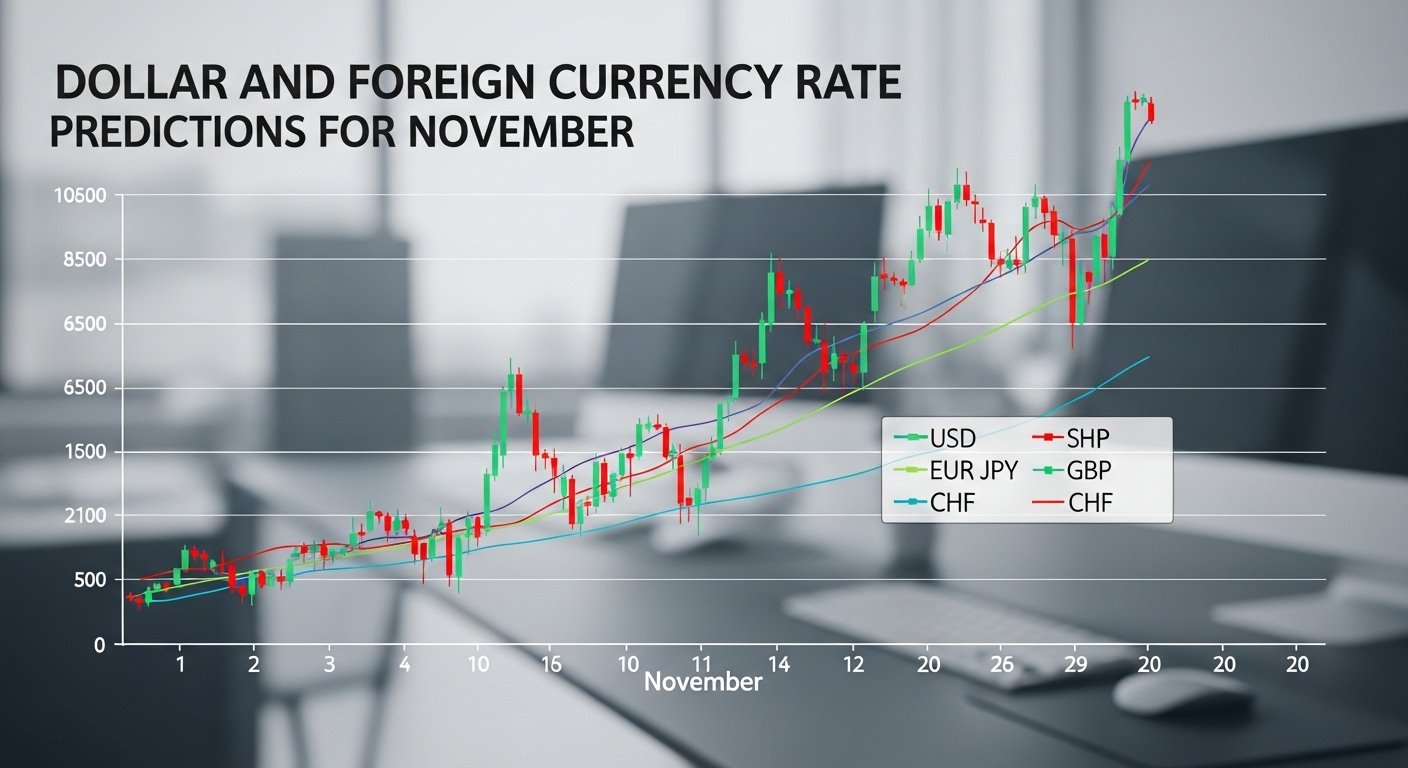
Current November 2025 Exchange Rates and Forecasts
EUR/USD: Euro Under Pressure
Current Rate (Early November): 1.1628 USD per EUR
November Trading Range: 1.1570 to 1.1810 USD per EUR
3-Month Target: 1.16 USD per EUR
Year-End 2025 Forecast: 1.20 USD per EUR
12-Month Target (November 2026): 1.24 USD per EUR
2026 Forecast: 1.22 USD per EUR
Current Outlook: EUR/USD faces strong headwinds as Federal Reserve policy uncertainty weighs on sentiment. The euro struggles against a resilient dollar supported by strong US economic data and persistent inflation expectations. However, medium-term factors favor euro appreciation, including improved Eurozone growth prospects, ECB policy firmness, and potential dollar weakness as Fed rate cuts accumulate.
GBP/USD: Sterling Under Siege
Current Rate (Early November): 1.3050 USD per GBP (down from earlier highs)
November Trading Range: 1.3020 to 1.3590 USD per GBP
Year-End 2025 Forecast: 1.32-1.36 USD per GBP
2026 Forecast: 1.39-1.40 USD per GBP (recovery expected)
Long-Term Projection (June 2026): 1.37 USD per GBP
Current Outlook: British Pound tumbled to six-month lows against the dollar in October 2025, reflecting domestic concerns including UK government autumn budget anxiety and potential tax increases threatening growth prospects. Sterling weakness also reflects market pricing of possible Bank of England rate cuts, potentially beginning in December 2025.
However, longer-term forecasts remain bullish. Analysts expect sterling recovery toward 1.39-1.40 by mid-2026 as weaker dollar influences accumulate and market participants price UK economic prospects.
USD/JPY: Yen Weakness Concerns Officials
Current Rate (Early November): Approximately 154-156 JPY per USD
November Trading Range: 151.00 to 157.80 JPY per USD
Q4 2025 Target: 152.00 JPY per USD
December 2025 Target: 152.00 JPY per USD
March 2026 Target: 150.00 JPY per USD
Year-End 2026 Target: 148.00 JPY per USD
Current Outlook: The Japanese Yen weakens substantially against the dollar despite Finance Minister Katayama expressing concern abothe ut appreciation rate-of-change. USD/JPY remains elevated near 155, reflecting Japan’s continued monetary policy divergence from the Federal Reserve. The Bank of Japan signals hesitation in normalizing policy rates, maintaining the interest rate differential favoring dollar investment.
However, medium-term pressures support eventual yen appreciation. ING expects declining USD/JPY hedging costs and potential Bank of Japan rate hikes supporting gradual yen strength. By 2026, analysts anticipate USD/JPY declining toward 148-150 as policy convergence progresses.
Other Major Currencies:
USD/CAD (Canadian Dollar)
Current: ~1.38 CAD per USD
Q4 2025 Forecast: 1.36-1.37 range
The Canadian dollar receives support from commodity prices and modest interest rate differentials.
AUD/USD (Australian Dollar)
Current: 0.65 USD per AUD (depreciated from earlier highs)
Forecast: Supported by firmer global growth expectations and solid commodity demand
Reserve Bank of Australia holds rates at 3.6%, limiting rate-driven appreciation
USD/CNY (Chinese Yuan)
Current: 7.10-7.15 range
Forecast: People’s Bank of China maintains soft dollar peg, containing volatility
Key Drivers of November Currency Movements
Federal Reserve Policy Uncertainty
The Federal Reserve created conflicting signals regarding future rate cuts. Fed Chair Powell stated rate cuts are “not a foregone conclusion,” suggesting a potential pause in the cutting cycle. This hawkish messaging supported the dollar, pushing the Dollar Index (DXY) up 2% during October 2025 despite the ongoing government shutdown and the previous rate cut.
Current market expectations price the December 2025 rate cut probability at only 40-50%, substantially lower than earlier consensus expectations. These expectations support dollar strength into November despite pressure from prolonged government shutdown uncertainty.
US Economic Resilience
Strong US economic data continues to support dollar valuations. Employment remains solid, inflation remains elevated above Federal Reserve targets, and consumer spending demonstrates resilience. This economic strength justifies elevated US interest rates relative to other developed economies, attracting foreign capital seeking attractive yields.
European Economic Stabilization
Eurozone growth prospects improved recently following months of disappointing data. Fiscal stimulus expectations from the German government support medium-term growth prospects. The European Central Bank maintains a firm policy stance without aggressive rate-cut signaling, supporting euro valuations against currencies signaling more aggressive policy easing.
Bank of England Rate Cut Prospects
Bank of England’s rate decision on November 6, 2025, creates sterling volatility. Market participants assign a 40% probability to a potential 25 basis point rate cut, reflecting weaker inflation data and slowing growth concerns. Should the BoE cut rates, sterling would weaken substantially against the dollar. Conversely, a BoE pause would support sterling.
Bank of Japan Hesitation
Japan’s new leadership signals hesitation in normalizing monetary policy rates despite modest inflation increases. This policy inaction maintains negative interest rate differentials between Japan and other developed economies, encouraging capital outflows and yen weakness.
Geopolitical Uncertainties
Trade policy uncertainties, including USMCA negotiations, US-Mexico relations, and broader trade tensions, affect currency valuations. Concerns regarding USth government shutdown and fiscal policy uncertainty create headwinds for dollar-dependent trading partners’ currencies.
Analyst Predictions and Target Ranges
JPMorgan Forecasts
JPMorgan expects continued euro strength through 2026, projecting EUR/USD reaching 1.19 by September 2025, 1.20 by December 2025, and 1.22 by March 2026. The bank identifies “fair value” near 1.11-1.12 but expects medium-term drivers supporting continued appreciation.
GBP/USD forecasts target 1.36 by December 2025 with subsequent recovery toward 1.39 by March 2026. USD/JPY is expected to decline toward 141 by September 2025 and 140 by December 2025, with further weakness anticipated into 2026.
BNP Paribas Outlook
BNP Paribas expects renewed dollar weakness over the coming months, driven by policy uncertainty, erosion of safe-haven appeal, and anticipated additional Federal Reserve rate cuts. The bank targets 1.16 EUR/USD over three months and 1.24 over 12 months, representing significant euro appreciation.The
Swiss Franc’s strength receives support from elevated safe-haven demand. EUR/CHF targets 0.94 over 12 months, suggesting franc appreciation relative to the euro despite euro strength versus the dollar.
ING Predictions
ING expects mild USD/JPY bearish bias into late 2025 and 2026, with targets reaching 152 by Q4 2025, declining to 150 by Q1 2026, and approaching 148 by Q4 2026. The bank anticipates yen strengthening as interest rate differentials narrow through Fed cuts and potential Bank of Japan normalization.
ING maintains a bullish EUR/USD outlook into year-end 2025 despite recent weakness, arguing improved Eurozone growth and potentially peaking Fed hawkish repricing should support euro appreciation.
Monex Europe Analysis
Monex noted a dollar rebound during October 2025 despite political headwinds and a Fed rate cut. The lack of data catalysts weighed on currency market volatility, benefiting the dollar through safe-haven demand. However, Monex maintains a bearish long-term dollar outlook based on structural considerations.
Trading Economics Forecasts
Trading Economics projects GBP/JPY reaching 183.70 by Q4 2025 and 198.50 by one year forward, representing significant pound appreciation against the weakening yen. EUR/GBP forecasts remain contained in the 0.86-0.87 range, suggesting relative euro-pound stability.
Technical Analysis and Key Levels
EUR/USD Technical Levels
Resistance (Upside Targets): 1.1810-1.1820 USD per EUR
Support (Downside Targets): 1.1400-1.1570 USD per EUR
Critical Level: 1.15 represents a psychological threshold below which significant breakdown potential exists
The pair remains heavily influenced by dollar dynamics. Post-FOMC price action created speculation regarding potential breaks below the 1.15 level, though ING analysts argue fundamentals support 1.15 as likely support, not a breakdown point.
GBP/USD Technical Levels
Resistance (Upside Targets): 1.3590 USD per GBP
Support (Downside Targets): 1.3020 USD per GBP
Critical Level: 1.30 represents a six-month low, a significant support area
Sterling finds support above 1.30 despite October weakness. Technical recovery toward the 1.35-1.36 range remains possible if domestic concerns moderate and dollar weakness resumes.
USD/JPY Technical Levels
Resistance (Upside Targets): 157.80 JPY per USD
Support (Downside Targets): 151.00 JPY per USD
Technical Bias: Neutral to mildly bearish in the medium term
Recent Bank of Japan comments regarding possible intervention created volatility around current levels. Financial Minister Katayama’s acknowledgment that yen weakness rate-of-change represents concern suggests potential central bank intervention if USD/JPY appreciates substantially above 157-158.
Trading Recommendations and Strategies
EUR/USD Strategy
Medium-term bulls should accumulate on dips toward 1.1570-1.1600, targeting 1.1800-1.182resistance with a year-end 1.20 objective. However, near-term weakness remains possible if the Fed maintains a hawkish stance. Risk management requires stops below the 1.1400 support level.
GBP/USD Strategy
Sterling weakness below 1.3050 creates potential buying opportunities targeting the 1.3300-1.3400 range. However, an additional downside cannot be ruled out in the near term if the Bank of England cuts rates aggressively. Medium-term recovery toward 1.39-1.40 remains likely based on analyst consensus.
USD/JPY Strategy
Near-term USD/JPY strength toward 157-158 appears possible, but medium-term fundamentals support eventual yen appreciation. Traders should await potential Bank of Japan intervention signals before aggressive yen shorting. Long-term positions should favor JPY appreciation toward the 148-150 range by 2026.
Conclusion
November 2025 foreign exchange forecasts reflect complex interactions between diverging central bank policies, economic data, and geopolitical uncertainties. The US Dollar maintains near-term resilience supported by strong economic data and Fed policy uncertainty, but medium-term outlooks favor dollar weakness as rate-cut expectations increase.
The Euro faces current pressure from Fed uncertainty but benefits from medium-term Eurozone growth prospects and firm ECB policy, supporting appreciation toward 1.20-1.24 by late 2025 and 2026. Sterling weakness creates buying opportunities for longer-term investors anticipating recovery toward 1.39-1.40 by mid-2026. The Yen faces structural weakness through 2025 but should gradually appreciate toward 148-150 USD/JPY as policy convergence progresses into 2026.
Technical analysis identifies clear support and resistance levels, enabling disciplined trading strategies. Risk management and patience prove essential as near-term volatility persists amid policy uncertainty and data releases. Analysts overwhelmingly expect medium-term dollar weakness and major currency appreciation as Federal Reserve cuts accumulate and structural economic factors reassert influence over purely temporary policy effects.