
Understanding how to calculate exchange rates enables informed financial decisions without constant reliance on external converters. Whether conducting international business, traveling abroad, investing globally, or managing currency portfolios, the ability to manually calculate exchange rates proves invaluable. This comprehensive guide demonstrates multiple calculation methods, provides practical examples, and explains the mathematical principles underlying currency conversions.
Understanding Exchange Rate Basics
Before calculating exchange rates, understanding fundamental concepts proves essential.
What is an Exchange Rate?
An exchange rate represents the relative value between two currencies—how much of one currency exchanges for another. For example, EUR/USD = 1.15 means one Euro equals 1.15 US Dollars.
Bid and Ask Prices
Currency markets quote two prices simultaneously. The bid price represents what buyers offer (a lower price). The ask price represents what sellers request (a higher price). The difference constitutes the “spread”—the transaction cost or profit margin.
Direct vs. Indirect Quotes
Direct quotes express foreign currency values in domestic currency units. Indirect quotes express domestic currency values in foreign units. Understanding this distinction affects calculation direction and methodology.
Basic Exchange Rate Calculation Formula
The Fundamental Formula
The most straightforward exchange rate calculation uses this formula:
Converted Amount = Amount × Exchange Rate
Example 1: Converting Pounds to US Dollars
If the exchange rate is £1 = $1.24 USD, and you want to convert £5,000 to US Dollars:
Converted Amount = 5,000 × 1.24 = 6,200 USD
This multiplication applies when converting FROM the currency quoted as “1” TO the other currency in the rate.
Example 2: Converting US Dollars to Euros
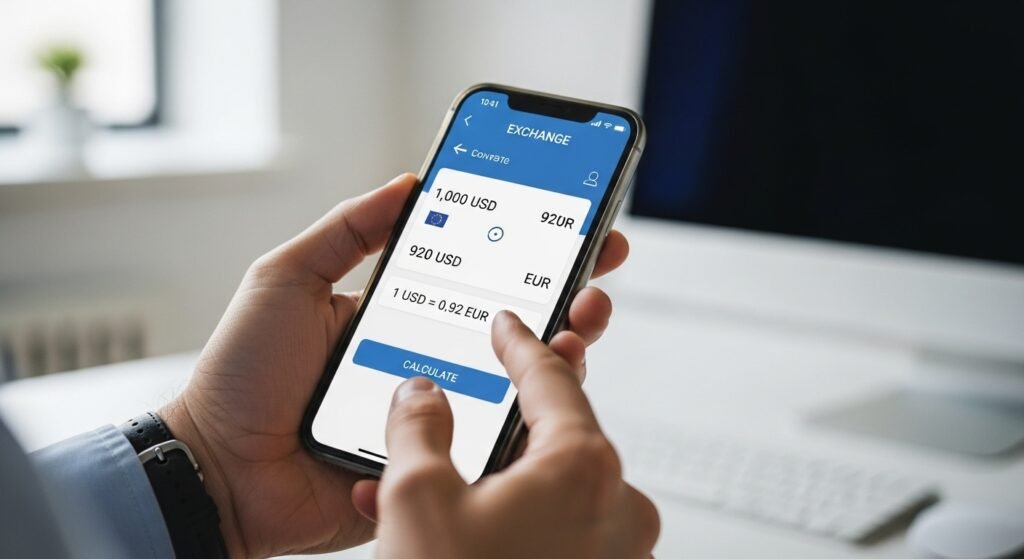
If the exchange rate is 1 USD = 0.92 EUR, and you want to convert $2,500 to Euros:
Converted Amount = 2,500 × 0.92 = 2,300 EUR
When to Multiply vs. Divide
Understanding multiplication versus division prevents calculation errors.
Multiply When Converting FROM the “1” Currency
If the exchange rate is expressed as “£1 = €1.17” and you want to convert pounds to euros, multiply the pound amount by 1.17.
Example: Convert £10.20 to euros
Calculation: 10.20 × 1.17 = 11.934 EUR
Divide When Converting TO the “1” Currency
If the exchange rate is expressed as “£1 = ₺12.81” and you want to convert Turkish lira back to pounds, divide the lira amount by 12.81.
Example: Convert ₺5,000 to pounds
Calculation: 5,000 ÷ 12.81 = 390.16 GBP
Calculating Reverse Exchange Rates
Understanding Reciprocal Rates
If you know one exchange rate direction, calculate the opposite direction through reciprocals. The reciprocal of any rate equals 1 divided by the original rate.
Example: If USD/EUR = 0.92, then EUR/USD = 1 ÷ 0.92 = 1.087
Practical Application
If EUR/USD = 1.15, calculate USD/EUR:
USD/EUR = 1 ÷ 1.15 = 0.87
This means 1 USD equals 0.87 EUR, or conversely, 1 EUR equals 1.15 USD.
Calculating Cross Rates
What Are Cross Rates?
Cross rates involve currency pairs not directly quoted against each other. When no direct exchange rate exists between two currencies, you must calculate through an intermediary currency (typically USD).
Cross Rate Formula
When both currencies are quoted against a common third currency (usually USD), calculate cross rates using:
Cross Rate = (Currency A to USD) ÷ (Currency B to USD)
Or alternatively:
Cross Rate = (Currency A to USD) × (USD to Currency B)
Example: Calculating EUR/JPY Cross Rate
Assume:
EUR/USD = 1.15
USD/JPY = 110.00
Calculate EUR/JPY (Euros to Japanese Yen):
EUR/JPY = 1.15 × 110.00 = 126.50
This means 1 Euro equals 126.50 Japanese Yen.
Alternative Cross Rate Method
If you have USD/EUR and USD/JPY rates:
Convert USD/EUR to EUR/USD: EUR/USD = 1 ÷ (USD/EUR)
Multiply EUR/USD by USD/JPY: EUR/JPY = EUR/USD × USD/JPY
Example calculation:
If USD/EUR = 0.87, then EUR/USD = 1 ÷ 0.87 = 1.149
If USD/JPY = 110, then EUR/JPY = 1.149 × 110 = 126.39
Complex Cross Rate Calculation: Three-Currency Method
Using Triangulation for Difficult Pairs
When dealing with exotic currency pairs, triangulation through multiple intermediary currencies may prove necessary.
Example: Calculate INR/AED (Indian Rupee to United Arab Emirates Dirham)
Assume available rates:
USD/INR = 74.50
USD/AED = 3.67
Calculate INR/AED:
Convert USD/INR to INR/USD: INR/USD = 1 ÷ 74.50 = 0.01342
Convert USD/AED to AED/USD: AED/USD = 1 ÷ 3.67 = 0.2725
Calculate INR/AED: INR/AED = 0.01342 × 3.67 = 0.04923
Therefore, 1 Indian Rupee = 0.04923 United Arab Emirates Dirhams.
Calculating Real Exchange Rates
Understanding Real vs. Nominal Rates
The real exchange rate adjusts nominal rates for price level differences (inflation) between countries.
Real Exchange Rate Formula
Real Exchange Rate = Nominal Rate × (Domestic Price Level ÷ Foreign Price Level)
Example: USD/EUR Real Rate Calculation
Given:
Nominal USD/EUR = 1.20
US Price Index = 100
Eurozone Price Index = 120
Real Rate = 1.20 × (100 ÷ 120) = 1.20 × 0.833 = 1.00
The real rate of 1.00 indicates purchasing power parity—one dollar possesses equivalent purchasing power to one euro when accounting for price differences.
Calculating Forward Exchange Rates
Forward Rates vs. Spot Rates
Forward rates represent agreed prices for future currency exchanges, differing from spot rates (immediate exchange). Forward rates incorporate interest rate differentials between currencies.
Forward Rate Calculation Principle
Forward Rate = Spot Rate ± Forward Points (Swap Rate)
The forward adjustment (swap rate) reflects interest rate differentials. If the quote currency has higher interest rates, forward rates trade at premiums (higher values). If lower interest rates, forward rates trade at discounts (lower values).
Example: AUD/USD Forward Rate
Given:
Spot AUD/USD = 0.5845/0.5866
Forward points (1-year bid) = +0.0062
Forward points (1-year ask) = +0.0053
Forward Rate (bid) = 0.5845 + 0.0062 = 0.5907
Forward Rate (ask) = 0.5866 + 0.0053 = 0.5919
The Australian Dollar strengthens (premium) because Australian interest rates exceed US rates.
Step-by-Step Exchange Rate Calculation Process
Step 1: Identify the Currency Pair
Determine which currencies you are converting. Define the source currency (the currency you possess) and the target currency (the currency you want to receive).
Step 2: Locate the Current Exchange Rate
Find current mid-market or spot rates through reliable sources, including XE.com, OANDA, or your financial institution’s rate quotes.
Step 3: Determine the Conversion Amount
Finalize the exact amount requiring conversion. Your amount may be fixed (converting a specific amount regardless of the rate) or rate-dependent (exchanging a specific amount to receive the target amount).
Step 4: Apply the Appropriate Formula
Select multiplication or division based on the quote direction:
Multiply if converting FROM the currency quoted as “1”
Divide if converting TO the currency quoted as “1”
Step 5: Execute the Calculation
Perform the arithmetic carefully, maintaining appropriate decimal places.
Step 6: Account for Fees and Spreads
If using commercial services (banks, exchange offices), add transaction costs, including:
Exchange spreads (bid-ask difference)
Service fees
Commission charges
Practical Example: Complete Currency Conversion
Scenario: UK Traveler Converting Pounds to Multiple Currencies
An individual possesses £1,00,0, requiring conversion to EUR, USD, and JPY.
Exchange rates:
£1 = €1.17
£1 = $1.24
£1 = ¥130
Conversions:
To Euros:
Amount = 1,000 × 1.17 = €1,170
To US Dollars:
Amount = 1,000 × 1.24 = $1,240
To Japanese Yen:
Amount = 1,000 × 130 = ¥130,000
These amounts represent mid-market conversions. Actual received amounts would be lower after banks or exchange services apply spreads and fees.
Common Calculation Errors to Avoid
Error 1: Multiplying When Should Divide (or Vice Versa)
Always verify quote direction. If EUR/USD = 1.15, converting Euros to dollars requires multiplication. Dividing would produce incorrect results.
Error 2: Forgetting to Account for Fees
Mid-market rates shown on calculators differ from actual rates received. Banks apply spreads (typically 2-4% for retail customers). Always calculate final amounts after fee deduction.
Error 3: Using Stale Exchange Rates
Exchange rates fluctuate constantly. Using outdated rates produces inaccurate calculations. Always verify current rates before executing significant conversions.
Error 4: Incorrectly Applying Cross Rate FormulaCross-ratete calculations require careful attention to whether rates require inversion. Applying the formula incorrectly produces nonsensical results—resulting “rates” may be extremely large or extremely small.
Error 5: Rounding Too Early
Intermediate calculations should maintain maximum decimal places, with rounding only applied to final results. Early rounding accumulates rounding errors in subsequent calculations.
Advanced Calculation: Triangulation Method
Using Three Currencies to Find Difficult Pairs
When currency pairs lack direct quotes, triangulation uses intermediate currency conversions.
Example: Calculate GBP/INR (British Pounds to Indian Rupees)
Available rates:
GBP/USD = 1.30
USD/INR = 74.50
Process:
Convert GBP to USD: £1 = $1.30
Convert USD to INR: $1 = ₹74.50
Calculate GBP/INR: £1 = ₹(1.30 × 74.50) = ₹96.85
Therefore, 1 British Pound equals 96.85 Indian Rupees.
Calculating Effective Exchange Rates
Understanding Trade-Weighted Rates
Effective exchange rates measure currency strength against baskets of trading partners’ currencies, reflecting overall competitiveness. Central banks and economists monitor effective rates to assess currency valuations.
Individual currency pair calculations remain the same, but cumulative effects across multiple pairs determine overall currency strength.
Conclusion
Calculating exchange rates manually requires understanding fundamental formulas, distinguishing between multiplication and division applications, and carefully managing cross-rate computations. The basic formula—Converted Amount = Amount × Exchange Rate—applies to straightforward conversions when quote currencies align correctly.
Cross rates enable calculating difficult pairs through intermediary currencies, typically USD. Forward rate calculations incorporate interest rate differentials affecting future exchange values. Real rate adjustments account for inflation differences, providing purchasing power comparisons.
Mastering exchange rate calculations prevents costly errors in international transactions, business dealings, and travel currency conversions. Maintain accuracy through proper decimal place management, careful attention to quote direction, and verification against current rates. Account for realistic fees when planning actual conversions, as calculated mid-market rates differ substantially from rates received after financial institution spreads and fees.