
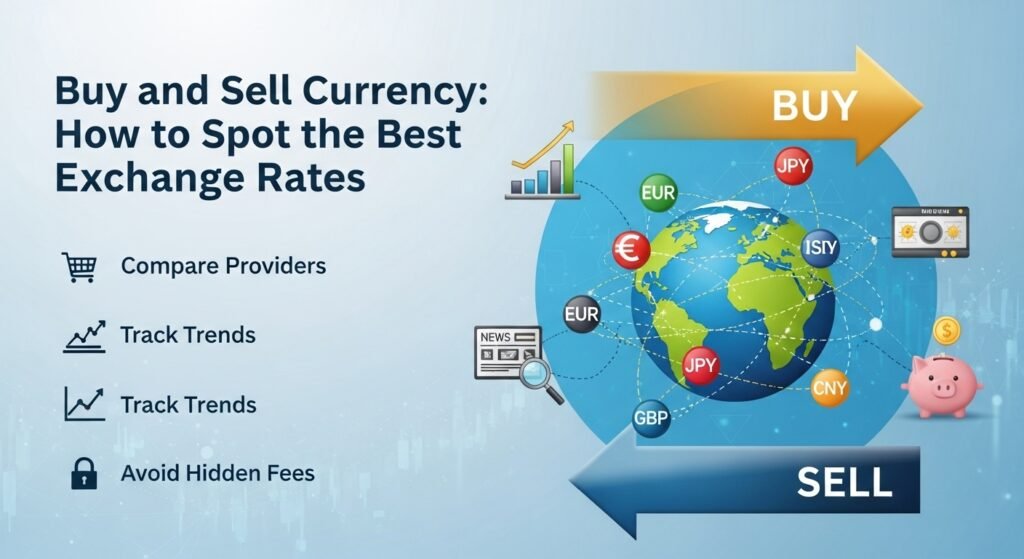
Identifying and obtaining optimal currency exchange rates requires understanding market mechanics, provider pricing structures, and strategic timing. Whether converting currencies for travel, international business, investment purposes, or personal transfers, understanding exchange rate components separates smart financial decisions from costly mistakes. This comprehensive guide explains how to recognize quality exchange rates, compare provider offerings, and implement timing strategies to maximize your currency conversion value.
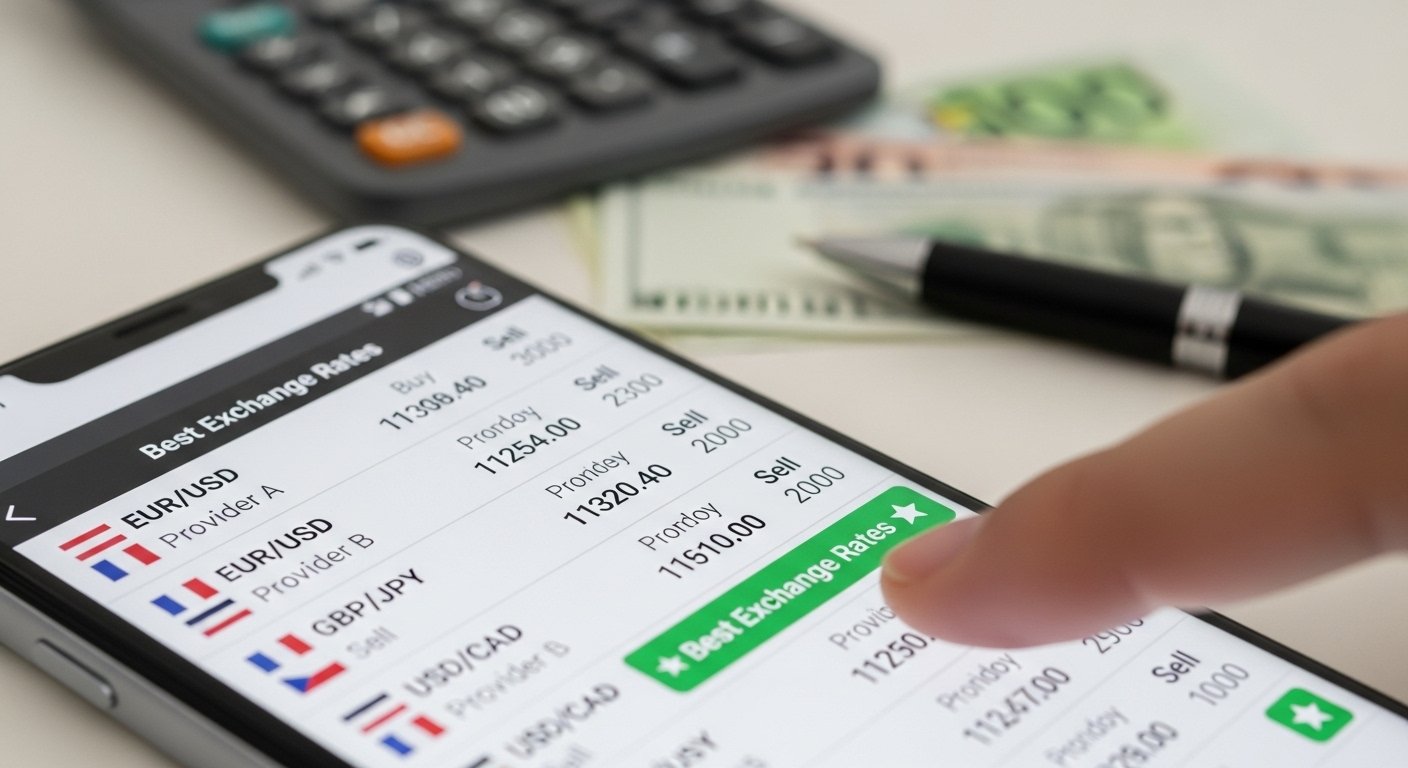
Understanding Exchange Rate Basics
Before spotting good rates, understanding fundamental concepts proves essential.
What Is the Mid-Market Rate?
The mid-market rate represents the “true” exchange rate—the midpoint between buying and selling prices in global currency markets. This rate reflects fair value without provider markups. Mid-market rates apply primarily to large institutional transactions between banks, not retail consumer transactions.
For example, if USD/EUR trades with a bid price of 0.85 and an ask price of 0.87, the mid-market rate is calculated as (0.85 + 0.87) / 2 = 0.86.
Understanding Bid and Ask Prices
Currency providers quote two prices simultaneously—the bid price and ask price.
The bid price represents the rate the provider offers when buying currency from you (when you are selling). If you hold Euros and want to sell them for dollars, the provider buys at the bid price.
The ask price represents the rate the provider charges when selling currency to you (when you are buying). If you want to buy Euros with dollars, the provider sells at the ask price.
Understanding the Spread
The difference between bid and ask prices constitutes the “spread”—the provider’s profit margin. A spread of 0.0009 USD on a GBP-USD pair means the provider profits 0.0009 on every pound exchanged.
Spreads vary based on liquidity and market conditions. Major currency pairs like EUR/USD feature narrow spreads (0.0001-0.0003) reflecting high trading volume and competition. Exotic or less-traded pairs show wider spreads (0.001-0.005), reflecting lower liquidity and higher risk.
Calculating and Identifying Markups
Understanding how providers mark up rates enables accurate cost evaluation.
The Mid-Market vs. Bank Rate Comparison
Most banks add 2-4% markups above mid-market rates. For example, if the mid-market rate shows 1 USD equals 0.92 EUR, a bank might quote 0.89 EUR (approximately 3% markup).
On a $1,000 conversion at mid-market rate, you receive €920. At bank rates with 3% markup, you receive only €8, 0 losing €30 on the transaction.
Calculating Markup Percentage
Use this formula to calculate your provider’s markup:
Markup % = (Your rate – Mid-market rate) / Mid-market rate × 100
Example calculation:
Mid-market rate: 1 GBP = 1.19 EUR
Bank quoted rate: 1 GBP = 1.13 EUR
Difference: 1.19 – 1.13 = 0.06
Markup %: (0.06 ÷ 1.19) × 100 = 5.04%
This 5% markup represents a substantial cost on larger transactions.
Finding Mid-Market Rates
Identify current mid-market rates through:
Google Currency Converter: Type “1 USD to EU ” to receive mid-market rates
XE.com: Provides real-time mid-market rates for 170+ currencies
OANDA: Displays historical rates and current mid-market values
Airwallex: Publishes mid-market rates for comparison purposes
Compare your provider’s quoted rate against these independent mid-market sources to quantify markup costs.
Comparing Buy and Sell Rates
Understanding buy and sell rate differences enables smarter conversion decisions.
When to Use Buy Rates
Use the buy rate when selling currency to a provider. If you hold foreign currency and want to convert it to your home currency, the provider buys your currency at the buy rate.
Example: Joyce wants to exchange $500 USD for Nigerian Naira. The provider’s buy rate is 750 NGN per USD. Joyce receives: 500 × 750 = 375,000 NGN.
When to Use Sell Rates
Use the sell rate when buying currency from a provider. If you want to obtain foreign currency, the provider sells it to you at the selling rate.
Example: Wale wants to buy $500 USD using Nigerian Naira. The provider’s sell rate is 770 NGN per USD. Wale pays: 500 × 770 = 385,000 NGN.
Notice the difference—Wale pays 10,000 NGN more than Joyce received for the same $500 USD. This spread represents the provider’s profit.
Identifying the Better Rate
When comparing providers, always look at the specific rate type relevant to your transaction.
If selling currency: Compare buy rates (higher is better)
If buying currency: Compare sell rates (lower is better)
Comparing buy rates when you need sell rates leads to incorrect provider selection.
Best Methods for Spotting Quality Rates
1. Compare Multiple Providers
Never accept the first quoted rate. Compare at least three providers, including:
Banks and credit unions (typically 2-4% markup)
Online money transfer services like Wise (typically 0.5-1.5% markup)
Currency exchange offices (varies widely, 1-3% markup typical)
Hotel exchange services (avoid—typically 5-10% markup)
Research different providers before committing to conversions. Rate differences of 0.5-2% significantly impact larger transactions.
2. Monitor Rate Trends
Track exchange rates over time, identifying favorable movement opportunities.
Use rate tracking apps and websites to monitor preferred currency pairs
Subscribe to rate alert notifications, triggering when rates reach specified levels
Observe weekly patterns, identifying optimal trading windows
For substantial conversions, monitor rates 1-2 weeks in advance to capture favorable opportunities.
3. Understand Timing Optimization
Strategic timing captures better rates based on trading volume and market activity.
Best Times:
Best hours: 9 AM to 1 PM during London-New York overlap (8 AM to 12 PM EST)
Best days: Tuesday through Thursday show stable rates with good liquidity
Avoid: Weekends, holidays, late evenings, Mondays (weekend news impacts), Fridays (position closing volatility)
During peak trading hours, competition between providers tightens, with ads offering better rates.
4. Avoid Dynamic Currency Conversion (DCC)
When shopping abroad or withdrawing from foreign ATMs, avoid merchant offers to charge your home currency (Dynamic Currency Conversion). These “convenience” offerings include substantial hidden markups (3-5% or higher).
Always request local currency charging, then convert later through optimal channels.
5. Avoid High-Markup Locations
Certain locations apply extraordinarily high markups:
Airport exchange: Typically 5-10% markup and excessive fees
Hotel currency desks: Usually 4-8% markup
Tourist-area exchange offices: Often 3-5% markup or higher
Tourist traps: Marked rates may be completely fabricated
Complete currency conversion through banks or online platforms before airport arrival, whenever possible.
6. Use Transparent Providers
Select providers clearly displaying rates and fees upfront:
Look for clearly posted buy and sell rates
Verify all fees appear explicitly (no hidden charges)
Research customer reviews and ratings
Confirm commercial licensing and regulatory compliance
Suspicious providers hiding rates or fees typically offer poor value.
Implementing a Strategic Exchange Approach
Step 1: Define Your Requirements
Clearly specify how much currency you require and your timeline. Different transaction sizes and time frames are optimized through different approaches.
Step 2: Identify Mid-Market Rates
Use Google, XE.com, or OANDA to establish current mid-market baselines.
Step 3: Compare Provider Rates Against Mid-Market
Contact or access at least three providers to obtain their buy and sell rates. Calculate markup percentages compared to atomid-market rates.
Step 4: Evaluate Total Costs
Consider both rate markups and explicit fees. Some providers charge flat fees (e.g., $15) while others charge percentages (1-2%).
Multiply the exchange rate against your conversion amount, then add fees, to calculate the total cost.
Step 5: Monitor Favorable Movements
For significant conversions, set rate alerts that trigger when rates reach acceptable thresholds. Execute the transaction when optimal conditions materialize.
Step 6: Execute Strategically
Complete conversions during business hours on weekdays through providers offering the best combined rates and fees.
Example: Complete Conversion Analysis
Scenario: Convert £1,000 to USD
Step 1: Mid-market rate check
Current mid-market: 1 GBP = 1.30 USD
Step 2: Provider comparison
Bank A: 1 GBP = 1.26 USD (2.9% markup) + $15 fee
Provider B: 1 GBP = 1.27 USD (2.3% markup) + 1% fee
Online Service C: 1 GBP = 1.29 USD (0.8% markup) + $8 fee
Step 3: Total cost calculation
Bank A: (1,000 × 1.26) + 15 = $1,275
Provider B: (1,000 × 1.27) + (1,270 × 0.01) = $1,289.70
Service C: (1,000 × 1.29) + 8 = $1,298
Step 4: Selection
Bank A provides the best value despite the fee, delivering $1,275 versus $1,298 from Service C—a $23 savings (1.8% better value).
Red Flags Indicating Poor Rates
Warning Signs:
Rates are significantly different from mid-market without explanation
Quotes are missing details about fees or additional charges
Providers resisting rate comparison or transparency requests
Extreme fees (5%+ of transaction amount)
Pressure to execute immediately without consideration of time
Refusal to provide written rate quotes
Unregistered or unlicensed exchange providers
Avoid providers exhibiting these warning signs.
Conclusion
Spotting the best currency exchange rates combines understanding rate mechanics, comparing providers strategically, and timing execution optimally. Calculate mid-market baseline rates through independent sources like Google, XE.com, or OANDA, then compare provider rates, quantifying markup costs.
Remember that buy rates apply when selling currency, while sell rates apply when buying currency—comparing mismatched rate types leads to incorrect provider selection. Most banks charge a 2-4% markup, while specialized online services typically charge a 0.5-1.5% markup.
Avoid airports, hotels, and tourist areas that apply substantial markups. Compare multiple providers before committing to conversions. Monitor rates over time, setting alerts for favorable conditions. Execute transactions during peak trading hours (9 AM to 1 PM London-New York overlap) on weekdays for optimal spreads.
By systematically implementing these strategies, typical currency conversions improve value by 1-3% compared to casual, unplanned conversions. For frequent international transactions or large conversion amounts, these accumulated savings prove substantial, making strategic rate evaluation an essential financial management practice.