
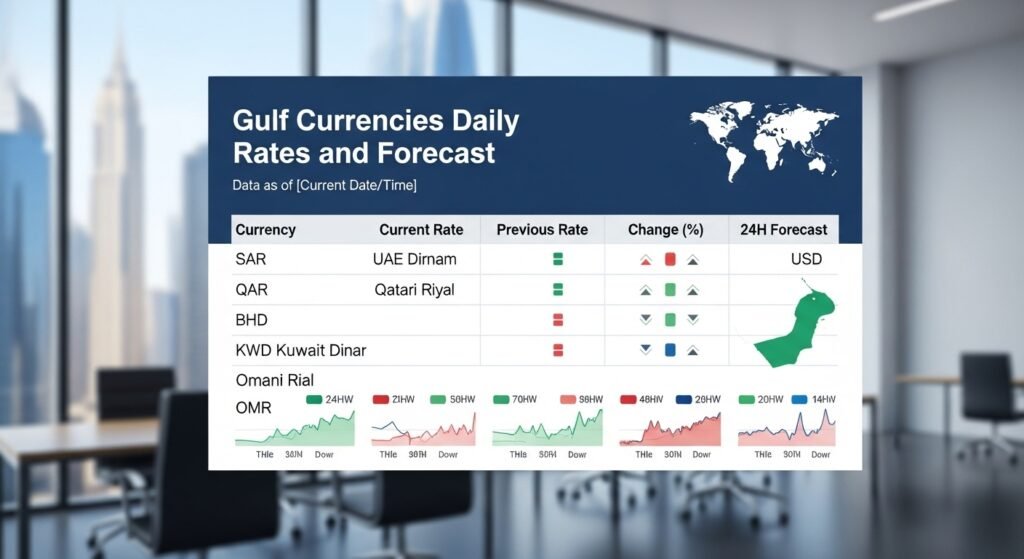
The Gulf Cooperation Council currencies represent some of the world’s most stable and predictable exchange rates. These currencies—maintained by six member nations (Saudi Arabia, United Arab Emirates, Kuwait, Qatar, Oman, and Bahrain)—offer remarkable consistency through fixed dollar pegs and sound monetary policies. Understanding current daily rates and future forecasts enables informed financial decisions for travelers, businesses, investors, and anyone conducting transactions within Gulf markets.
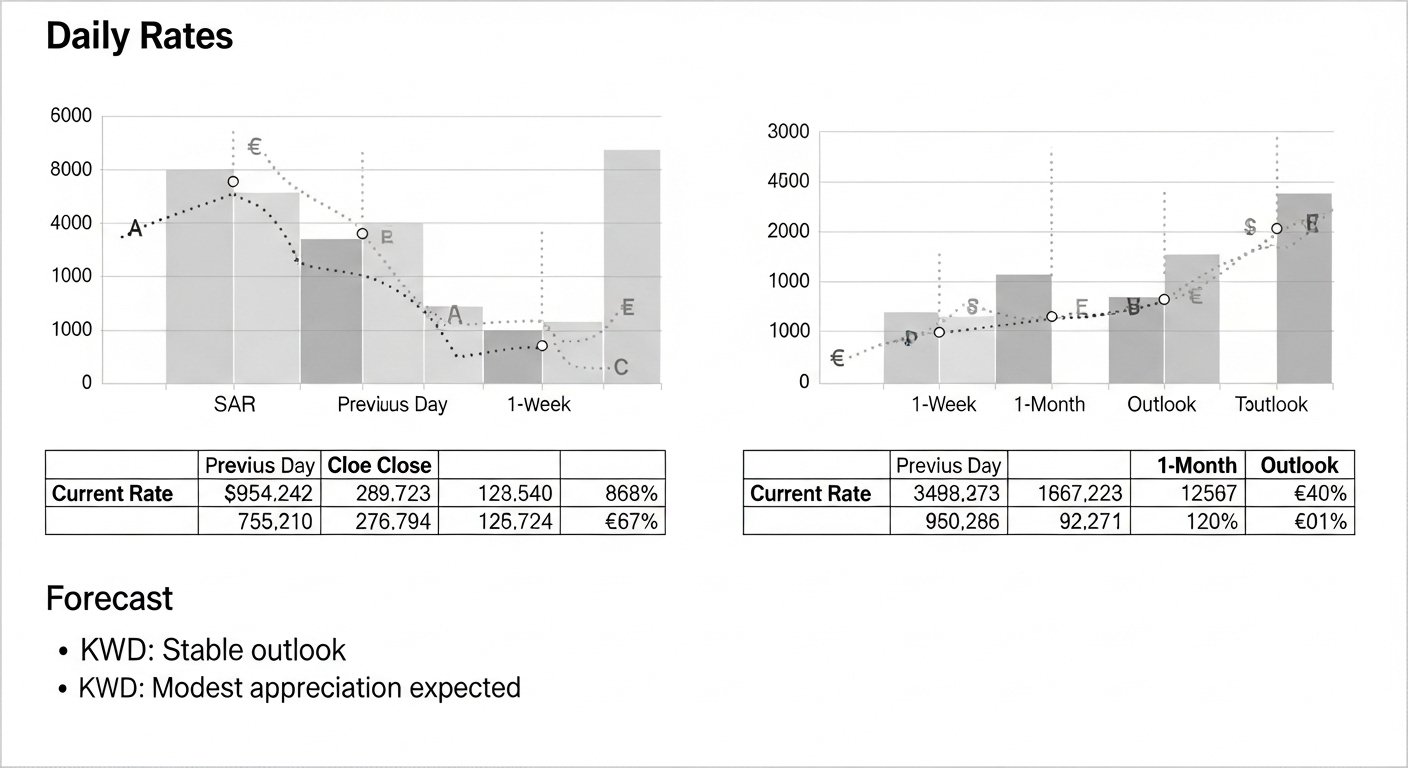
Current Gulf Currencies Daily Rates (November 15, 2025)
United Arab Emirates Dirham (AED)
1 AED = 0.2723 USD
1 AED = 4.27 EUR
1 AED = 0.1041 Bahraini Dinar (BHD)
Daily Rate Status: Fixed peg at 3.6725 AED per USD maintained
Saudi Arabian Riyal (SAR)
1 SAR = 0.2667 USD
1 SAR = 1.021 AED
1 SAR = 4.37 EUR
Daily Rate Status: Fixed peg at 3.75 SAR per USD maintained
Kuwaiti Dinar (KWD)
1 KWD = approximately 3.29 USD (calculated from basket peg)
1 KWD = 1.141 AED
1 KWD = 1.259 OMR
1 KWD = 11.88 QAR
Daily Rate Status: Transitioned from dollar peg to currency basket in May 2025
Qatari Riyal (QAR)
1 QAR = 0.991 AED
1 QAR = approximately 0.274 USD (calculated)
1 QAR = 5.07 EUR (calculated)
Daily Rate Status: Fixed peg at 3.64 QAR per USD maintained
Omani Rial (OMR)
1 OMR = 0.1045 AED
1 OMR = 0.795 KWD
1 OMR = approximately 0.385 USD (calculated)
Daily Rate Status: Fixed peg at approximately 2.60 OMR per USD maintained
Bahraini Dinar (BHD)
1 BHD = 9.767 AED
1 BHD = approximately 0.377 USD (calculated)
Daily Rate Status: Fixed peg at 2.659 BHD per USD maintained
Gulf Currency Conversion Quick Reference Table
From 1 Unit to USD and AED:
| Currency | To USD | To AED | Symbol |
|---|---|---|---|
| AED | 0.2723 | 1.0000 | د.إ |
| SAR | 0.2667 | 1.0211 | ر.س |
| KWD | ~3.2927 | 11.4113 | د.ك |
| QAR | 0.2747 | 0.9912 | ر.ق |
| OMR | 0.3846 | 1.4109 | ر.ع. |
| BHD | 0.3774 | 1.3854 | د.ب |
Understanding Gulf Currency Stability
Fixed Dollar Peg System
The majority of Gulf currencies maintain fixed exchange rate pegs to the US Dollar, reflecting fundamental economic relationships and policy decisions. These fixed relationships ensure remarkable currency stability absent in most international currency pairs.
Fixed dollar pegs create several advantages for Gulf economies. Oil exports are transacted primarily in US Dollars, making dollar pegging align perfectly with natural revenue flows. The peg anchors monetary policy, preventing inflationary expansion while maintaining investor confidence through predictable exchange rates.
Kuwait’s Transition to Currency Basket (May 2025)
Kuwait implemented a significant policy shift in May 2025, abandoning its dollar peg in favor of a weighted currency basket arrangement. This transition reflects Kuwait’s desire for greater monetary flexibility while maintaining exchange rate stability. The basket includes multiple currencies with primary weighting toward the US Dollar alongside diversification toward other reserve currencies.
Since abandoning the peg, the Kuwaiti Dinar has appreciated approximately 4% against the US Dollar by September 2025, reflecting basket-determined valuations diverging from strict dollar pegging.
Historical Rate Trends Throughout 2025
Kuwaiti Dinar to Omani Rial (KWD to OMR)
The KWD to OMR rate exhibited minimal volatility throughout 2025, reflecting both currencies’ dollar peg stability:
Highest Rate: 1.2609 OMR per KWD (September 16, 2025)
Lowest Rate: 1.2449 OMR per KWD (February 17, 2025)
Average Rate: 1.2541 OMR per KWD
Annual Movement: 0.44% appreciation
Current (November 15): 1.259 OMR per KWD
This narrow trading range reflects both currencies’ structural stability through dollar pegging.
Kuwaiti Dinar to Qatari Riyal (KWD to QAR)
Similar stability characterized KWD to QAR movements throughout 2025:
Average Rate: 11.8769 QAR per KWD
Highest Rate: Approximately 11.94 QAR (recorded mid-year)
Lowest Rate: 11.7853 QAR (February 17, 2025)
Current (November 15): 11.88 QAR per KWD
GCC Economic Outlook and Currency Forecasts
2025 Economic Growth Projections
The Gulf Cooperation Council region demonstrates robust economic expansion forecasts:
GCC GDP Growth 2025: 3.9% to 4.1% (accelerating from 1.8% in 2024)
GCC GDP Growth 2026: 4.3% to 4.6% (further acceleration)
Inflation Rate 2025: 1.7% (exceptionally low globally)
Inflation Rate 2026: 2.0%
These growth rates reflect oil production increases, ongoing economic diversification, and successful reform implementations supporting long-term economic resilience.
Individual Nation Forecasts
Saudi Arabia maintains a stable economic momentum with projected growth of around 4% in 2025-2026. UAE continues strong performance with similar growth trajectories. Kuwait experienced transition impacts from basket peg adoption but maintains economic fundamentals. Qatar sustains stable growth driven by energy and non-energy sectors.
Currency Stability Outlook
Most Gulf currencies should maintain current peg values and exchange rate stability through 2025-2026, supported by:
Strong foreign exchange reserves
Fiscal surplus positions
Stable oil market conditions
Consistent monetary policy coordination
Kuwait’s basket peg may experience periodic fluctuations reflecting global currency market movements while maintaining effective stability within the basket framework.
Factors Supporting Gulf Currency Stability
Oil Export Revenues
Gulf nations derive substantial revenues from petroleum exports transacted in US Dollars. This natural dollar demand supports dollar peg sustainability while providing substantial foreign exchange reserves, enabling exchange rate defense if necessary.
Fiscal and Reserve Strength
GCC member nations maintain exceptionally strong government fiscal positions with projected gross debt averaging just 28-32.5% of GDP—among the lowest globally. Foreign exchange reserves substantially exceed requirements for maintaining exchange rate pegs indefinitely.
Monetary Policy Coordination
GCC central banks coordinate monetary policies, maintaining policy consistency, supporting currency stability. Saudi Central Bank, Qatar Central Bank, and others maintain policy rates aligned with their respective pegs while supporting regional economic objectives.
Low Inflation Environment
GCC inflation remains among the world’s lowest, averaging 1.7% in 2025 compared to global averages exceeding 3-4%. Low inflation supports stable purchasing power and reduces devaluation pressure on currencies.
Geopolitical Risk Management
Fixed exchange rate pegs provide an anchor of stability, ty insulating Gulf economies from external shocks and geopolitical uncertainties common throughout the Middle East region.
Daily Rate Monitoring and Tracking Methods
Central Bank Official Rates
Central banks publish official exchange rates used for official transactions and government accounting. The Central Bank of Kuwait, the UAE Central Bank, the Qatar Central Bank, and others maintain official rate publications.
Online Currency Converters
Dedicated platforms, including XE.com, Wise, OANDA, and exchange-rates.org, provide real-time Gulf currency rate tracking. Most display current rates with historical data, enabling trend analysis.
Financial News Platforms
Bloomberg, Trading Economics, and financial news services publish Gulf currency rates alongside economic analysis and market commentary.
Bank Digital Platforms
Banks throughout Gulf nations provide online currency rate displays enabling customer rate monitoring and transaction planning.
Conversion Recommendations and Best Practices
Monitor Official Rates
Central bank official rates represent authoritative current rates. Comparing bank and provider rates against official rates enables identifying markups and service charges.
Compare Multiple Providers
Different providers quote varying rates reflecting their markup policies. Comparing at least three providers before converting optimizes exchange value.
Execute During Business Hours
Gulf currency conversions during regular business hours capture optimal rates. Weekend and holiday conversions incur higher markups due to market closures.
Consolidate Transactions
Converting larger amounts simultaneously typically generates better rates than multiple small conversions. Consolidation reduces conversion frequency and fees.
Avoid Airport Exchanges
Airport currency booths apply extraordinarily high markups. Complete conversions before airport arrival through banks or online platforms offering substantially better rates.
Conclusion
Gulf currencies maintain exceptional stability through fixed dollar pegs and robust economic fundamentals. Current November 2025 rates reflect these stable arrangements with AED at 3.6725 per USD, SAR at 3.75 per USD, and other currencies maintaining established pegs. Kuwait’s May 2025 transition to basket pegging represents a notable policy shift, creating measured flexibility within continued stability.
The GCC region demonstrates robust economic growth forecasts exceeding 4% annually through 2026, supported by oil production increases, economic diversification, and successful reform implementations. Low inflation environment, strong fiscal positions, and substantial foreign exchange reserves underpin currency stability, supporting long-term investment confidence.
Understanding current rates, historical trends, and economic fundamentals enables informed financial decision-making for Gulf region transactions. Strategic provider selection, rate comparison, and timing optimization maximize conversion value while minimizing unnecessary fees. The Gulf currencies’ exceptional stability distinguishes regional financial operations from most international currency pairs, supporting reliable transaction planning and long-term business investments.